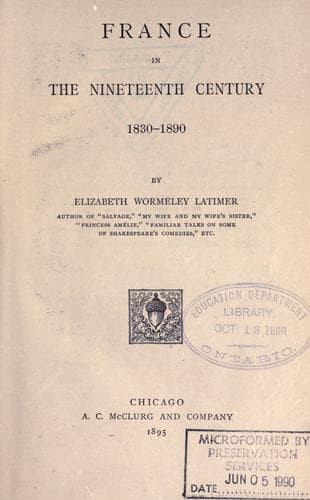
France in the Nineteenth CenturyLatimer, Elizabeth Wormeley
History
France in the Nineteenth Century
Latimer, Elizabeth Wormeley
France -- History -- 1789-1900
In 1834, a young Arab chief called Abdul Kader, the son of a Marabout
of great sanctity, had risen into notice. Abdul Kader was a man
who realized the picture of Saladin drawn by Sir Walter Scott in
the "Talisman." Brave, honorable, chivalrous, and patriotic, his
enemies admired him, his followers adored him. When he made his
first treaty with the French, he answered some doubts that were
expressed concerning his sincerity by saying gravely: "My word
is sacred; I have visited the tomb of the Prophet."
Constantine, the mountain fortress of Oran, was held, not by Abdul
Kader, but by Ahmed Bey, the representative of the sultan's suzerainty
in the Barbary States. The first attack upon it failed. The weather
and the elements fought against the French in this expedition.
General Changarnier distinguished himself in their retreat, and
the Duc de Nemours showed endurance and bravery.
From the moment of that repulse, popular enthusiasm was aroused.
A cry rang through France that Constantine must be taken. It was
captured two years later, after a siege in which two French
commanders-in-chief and many generals were killed. Walls fell,
and mines exploded; the place at last was carried by assault. At
one moment, when even French soldiers wavered, a legion of foreign
dare-devils (chiefly Irishmen and Englishmen) were roused by an English
hurrah from the man who became afterwards Marshal Saint-Arnaud. With
echoing cheers they followed him up the breach, the army followed
after them, and the city was won.
Louis Philippe had been raised to power by four great men,--Lafayette,
Laffitte, Talleyrand, and Thiers. Of these, Laffitte and Lafayette
retained little influence in his councils, and both died early
in his reign. In 1838 died Talleyrand,--the prince of the old
diplomatists. The king and his sister, Madame Adélaïde, visited
him upon his death-bed. Talleyrand, supported by his secretary,
sat up to receive the king. He was wrapped in a warm dressing-gown,
with the white curls he had always cherished, flowing over his
shoulders, while the king sat near him, dressed in his claret-colored
coat, brown wig, and varnished boots. Some one who was present
whispered that it was an interview between the last of the _ancienne
noblesse_ and the first citizen _bourgeois_. Rut the old courtier
was touched by the intended kindness, and when the king was about
to go away, he said, half rising: "Sire, this honor to my house
will be gratefully remembered in the annals of my family."
Deep and true was the grief felt for the loss of Talleyrand in
his own household; many and bitter have been the things said of
his character and his career. He himself summed up his life in some
words written shortly before his death, which read like another
verse in the Book of Ecclesiastes:--
Public-domain text, read in full here on John Shaqi.
Reviews
Reviews
No reviews yet
Be the first to share your thoughts on this work.
Elsewhere in the archive
Join the Discussion
Join the discussion
Sign in to leave a comment or review.
Sign InorCreate an account