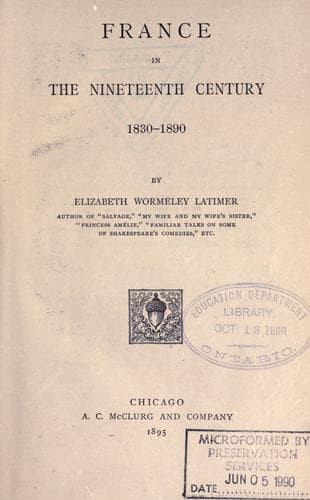
France in the Nineteenth CenturyLatimer, Elizabeth Wormeley
History
France in the Nineteenth Century
Latimer, Elizabeth Wormeley
France -- History -- 1789-1900
"Eighty-three years have rolled away! How many cares, how many
anxieties! How many hatreds have I inspired, how many exasperating
complications have I known! And all this with no other result than
great moral and physical exhaustion, and a deep feeling of
discouragement as to what may happen in the future,--disgust, too,
as I think over the past."
A writer in "Temple Bar" (probably Dr. Jevons) speaks of Prince
Talleyrand thus:--
"On his private life it would be unfair to pass judgment without
taking into consideration the turbulence and lawlessness, the immorality
and corruption both social and political, which characterized the
stormy epoch in which he was called to play a very prominent part.
If he did not pass through it blameless, he was less guilty than
many others; if his hands were not pure, at least they were not
blood-stained; and it is possible that, as Bourienne, who knew
him well, says: 'History will speak as favorably of him as his
contemporaries have spoken ill.'"
The summer of 1840 seemed peaceful and serene, when a storm burst
suddenly out of a cloudless sky. It was a new phase of that Eastern
Question which unhappily was not settled in the days of the Crusades,
but has survived to be a disturbing element in the nineteenth century.
Two men were engaged in a fierce struggle in the East, and, as usual,
they drew the Powers of the West and North into their quarrel.
Sultan Mahmoud, who had come to the throne in 1808, had done his
best to destroy the power of his pashas. He hated such powerful and
insubordinate nobles, and after the destruction of the Mamelukes
in 1811, he placed Egypt under the rule of the bold Macedonian
soldier, Mehemet Ali, not as a pasha, but as viceroy. In course
of time, as the dominions of Sultan Mahmoud became more and more
disorganized by misgovernment and insurrection, Mehemet Ali sent
his adopted son, Ibrahim Pasha, with an army into Syria. Ibrahim
conquered that province and governed it far better than the Turks
had done, when he was stopped by a Russian army (1832), which,
under pretence of assisting the sultan, interfered in the quarrel.
An arrangement was effected by what is called the treaty of
Unkiar-Thelessi. Ibrahim was to retain the pashalik of Syria for
his life, and Russia stipulated that no vessels of war should be
allowed to pass the Dardanelles or Hellespont without the consent
of the sultan.
Public-domain text, read in full here on John Shaqi.
Reviews
Reviews
No reviews yet
Be the first to share your thoughts on this work.
Elsewhere in the archive
Join the Discussion
Join the discussion
Sign in to leave a comment or review.
Sign InorCreate an account