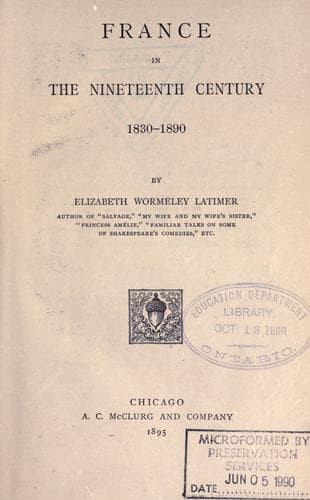
France in the Nineteenth CenturyLatimer, Elizabeth Wormeley
History
France in the Nineteenth Century
Latimer, Elizabeth Wormeley
France -- History -- 1789-1900
At the gate of the Invalides was another genuine statue, Napoleon
in his imperial robes was holding forth the cordon of the Legion
of Honor. This statue had been executed for the Pillar at Boulogne
commemorative of the Army of England. It was surrounded by plaster
statues of the departments of France, and was approached through a
long line of marshals, statesmen, and the most illustrious of French
kings, among them Louis XIV., who would have been much astonished to
find himself rendering homage to a soldier of barely gentlemanly
birth, born on an island which was not French in his time.
The coffin was borne by sailors into the Chapelle Ardente at the
Invalides. "Sire," said Prince de Joinville to his father, "I present
to you the body of the Emperor Napoleon."
"I receive it in the name of France," replied the king.
Then Marshal Soult put the Emperor's sword into the king's hand.
"General Bertrand," said the king, "I charge you to lay it on the
coffin of the Emperor. General Gourgaud, place the Emperor's hat
also on the coffin."
Then began the appropriate religious ceremonies, and during the
following week the public were admitted to view the coffin as it
lay in state in the Chapelle Ardente. The crowd was very great.
Women fainted daily, and many were almost pressed to death against
the gilded rails.
After all, there was little to see. The coffin was enclosed in a
sort of immense cage to keep it from intrusion, the air was heavy
with incense, and the light was too dimly religious to show anything
with distinctness.
A splendid tomb has since been erected to Napoleon in the Chapel
of the Invalides, where he rests under the care of the war-worn
soldiers of France. Few now can be living who fought under him.
Not a Bonaparte was at his funeral; the only one then upon French
soil was in a prison.
Napoleon sleeps where in his will he prayed that his remains might
rest,--on the banks of the Seine.
CHAPTER V.
SOME CAUSES OF THE REVOLUTION OF 1848.
After the signing of the treaty of 1841, which restored the _entente
cordiale_ between France and England, and satisfied the other European
Powers, Louis Philippe and his family were probably in the plenitude
of their prosperity. The Duke of Orleans had been happily married;
and although his wife was a Protestant,--which was not wholly
satisfactory to Queen Marie Amélie,--the character of the Duchesse
Hélène was so lovely that she won all hearts, both in her husband's
family and among the people.
Public-domain text, read in full here on John Shaqi.
Reviews
Reviews
No reviews yet
Be the first to share your thoughts on this work.
Elsewhere in the archive
Join the Discussion
Join the discussion
Sign in to leave a comment or review.
Sign InorCreate an account