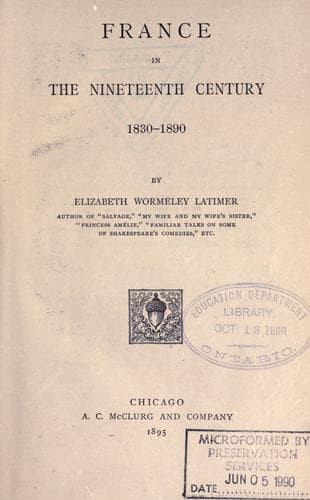
France in the Nineteenth CenturyLatimer, Elizabeth Wormeley
History
France in the Nineteenth Century
Latimer, Elizabeth Wormeley
France -- History -- 1789-1900
"The _curé_ of Neuilly came and administered the sacrament while
we were all on our knees around the pallet, weeping and praying.
I unloosed from my neck a small cross containing a fragment of the
True Cross, and I put it into the hand of my poor child, that God
the Saviour might have pity on him in his passage into eternity.
Dr. Pasquier got up and whispered to the king. Then that venerable
and unhappy father, his face bathed in tears, knelt by the side
of his eldest son, and tenderly embracing him, cried; 'Oh that
it were I instead of thee!' I also drew near and kissed him three
times,--once for myself, once for Hélène, and once for his children.
I laid upon his lips the little cross, the symbol of our redemption,
and then placed it on his heart and left it there. The whole family
kissed him by turns, and then each returned to his place.... His
breathing now became irregular. Twice it stopped, and then went
on. I asked that the priest might come back and say the prayers
for the dying. He had scarcely knelt down and made the sign of
the cross, when my dear child drew a last deep breath, and his
beautiful, good, generous, and noble soul left his body.... The
priest at my request said a _De profundis_. The king wanted to
lead me away, but I begged him to allow me to embrace for the last
time my beloved son, the object of my deepest tenderness. I took
his dear head in my hands; I kissed his cold and discolored lips;
I placed the little cross again upon them, and then carried it
away, bidding a last farewell to him whom I loved so well,--perhaps
too well!
"The king led me into the next room. I fell on his neck. We were
unhappy together. Our irreparable loss was common to us both, and
I suffered as much for him as for myself. There was a crowd in that
little room. I wept and talked wildly, and I was beside myself.
I recognized no one but the unhappy Marshal Gérard, the extent of
whose misfortune I then understood.[1] After a few minutes they
said that all was ready. The body had been placed on a stretcher
covered with a white cloth. It was borne by four men of the house,
attended by two gendarmes. They went out through the stable-yard;
there was an immense crowd outside.... We all followed on foot
the inanimate body of this dear son, who a few hours before had
passed over the same road full of life, strength, and happiness....
Thus we carried him, and laid him down in our dear little chapel,
where four days before he had heard mass with the whole family."
[Footnote 1: Marshal Gérard was then mourning for his son.]
The death of the Duke of Orleans was the severest blow that could
have fallen on Louis Philippe, not only as a father, but as head
of a dynasty. The duke left two infant sons,--the Comte de Paris
and the Duc de Chartres. The former is now both the Orleanist and
Legitimist pretender, to the French throne.
Public-domain text, read in full here on John Shaqi.
Reviews
Reviews
No reviews yet
Be the first to share your thoughts on this work.
Elsewhere in the archive
Join the Discussion
Join the discussion
Sign in to leave a comment or review.
Sign InorCreate an account