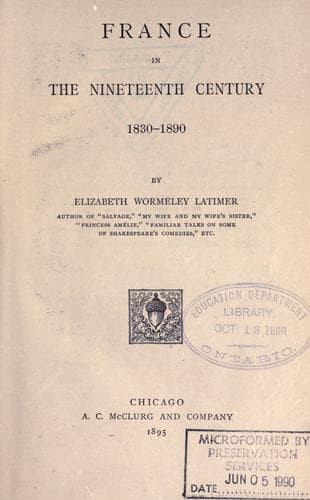
France in the Nineteenth CenturyLatimer, Elizabeth Wormeley
History
France in the Nineteenth Century
Latimer, Elizabeth Wormeley
France -- History -- 1789-1900
In the early part of 1845 Louis Philippe, who had already visited
Windsor and been cordially received there, was visited in return at
his Château d'Eu by Queen Victoria and Prince Albert, accompanied
by Lord Aberdeen, then English Minister for Foreign Affairs. The
king's reception of the young queen was most paternal. He kissed
her like a father, and did everything in his power to make her
visit pleasant. Among the subjects discussed during the visit was
the question of "the Spanish marriages."
The unfortunate Queen of Spain, Isabella II., was just sixteen years
old; her sister, the Infanta Luisa, was a year younger. Isabella
was the daughter of a vicious race, and with such a mother as she
had in Queen Christina, she had grown up to early womanhood utterly
ignorant and untrained. One of her ministers said of her that "no
one could be astonished that she had vices, but the wonder was
that she had by nature so many good qualities." Jolly, kindly,
generous, a rebel against etiquette, and an habitual breaker of
promises, she was long popular in Spain, in spite of a career of
dissoluteness only equalled by that of Catherine of Russia.
In 1846, however, she had not shown this tendency, and in the hands
of a good husband might have made as good a wife and as respectable
a woman as her sister Luisa has since proved.
There were many candidates for the honor of Queen Isabella's hand.
Louis Philippe sent his sons D'Aumale and Montpensier to Madrid to
try their fortunes; but England objected strongly to an alliance
which might make Spain practically a part of France. The candidature
of the French princes was therefore withdrawn.
A prince of the Catholic branch of the Coburgs was then
proposed,--Prince Ferdinand, who made subsequently an excellent
king-consort in Portugal; but to him France objected, as too nearly
allied to the English Crown. Finally the suitors were reduced to
three,--the queen's cousin Enrique (Henry), a rough sailor of rather
radical opinions and turbulent ways; the Comte de Trepani, a Neapolitan
prince, a man of small understanding; and another cousin, Don Francisco
d'Assis, a creature weak alike in mind and body, whom it was an
outrage to think of as fit mate for a young queen. England was
willing to consent to the queen's marrying anyone of these princes,
and also that the Duc de Montpensier should marry the Infanta Luisa,
provided that the queen was first married and had had a child. All
this was fully agreed upon in the conference at Eu. But Christina,
the queen-mother, who had been plundering the Spanish treasury till
she had accumulated an enormous fortune, offered, if Louis Philippe
would use his influence to prevent any inquiry into the state of
her affairs, to further his views as to the Duc de Montpensier.
Public-domain text, read in full here on John Shaqi.
Reviews
Reviews
No reviews yet
Be the first to share your thoughts on this work.
Elsewhere in the archive
Join the Discussion
Join the discussion
Sign in to leave a comment or review.
Sign InorCreate an account