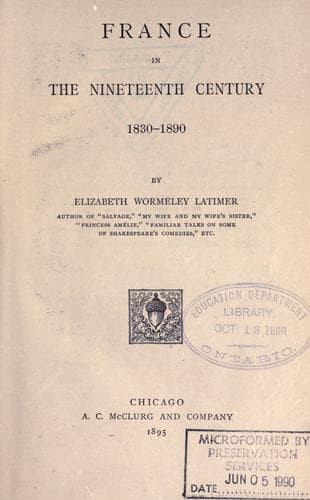
France in the Nineteenth CenturyLatimer, Elizabeth Wormeley
History
France in the Nineteenth Century
Latimer, Elizabeth Wormeley
France -- History -- 1789-1900
It seems more like a scene in the Middle Ages than an actual transaction
in our own century, that at midnight, in a Spanish palace, a dissolute
Italian dowager and a French ambassador should have been engaged
in coercing a sovereign of sixteen into a detested marriage. As
morning dawned, the sobbing girl had given her consent to marry
Don Francisco, and the ambassador of Louis Philippe, pale from
the excitement of his vigil, left the palace to send word of his
disgraceful victory to his master. The Duc de Montpensier, who was
in waiting on the frontier, soon arrived in Madrid, and Isabella
and Luisa were married on the same day; while M. Guizot, who was
head of the French Government, and Louis Philippe excused their
breach of faith to the queen of England by saying that Queen Isabella
_was_ married before her sister, though on the same morning.
Isabella at once banished her unwelcome husband to a country seat,
and flung herself headlong into disgraceful excesses.
Queen Victoria was greatly hurt by the treachery displayed by Louis
Philippe and his minister, and doubtless, as a woman she was deeply
sorry for the young queen. Louis Philippe not only lost credit,
popularity, and the support he derived from the personal friendship
of the Queen and the Prince Consort of England, but he obtained no
chance of the throne of Spain for his son by his wicked devices;
for Queen Isabella, far from being childless, had three daughters
and a son. The latter, subsequently Alfonso XII., married, in spite
of much opposition, his lovely cousin Mercedes, daughter of the
Duke and Duchess of Montpensier. She died a few months after her
marriage, so that no son or grandson of Louis Philippe will be
permitted by Providence to mount the Spanish throne.
The affair of the Spanish marriages, the quarrel it involved with
Queen Victoria, and the loss to Louis Philippe of personal honor,
had a great effect upon him; he became irritable and obstinate,
and at the same time weak of will.
Troubles multiplied around him. Things with which he had nothing
whatever to do increased his unpopularity, and the secret societies
kept discontents alive. Everything that went wrong in France was
charged upon the king and the royal family.
Public-domain text, read in full here on John Shaqi.
Reviews
Reviews
No reviews yet
Be the first to share your thoughts on this work.
Elsewhere in the archive
Join the Discussion
Join the discussion
Sign in to leave a comment or review.
Sign InorCreate an account