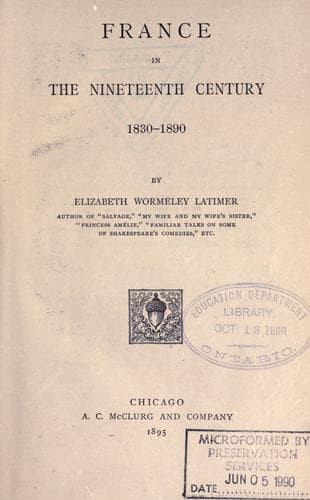
France in the Nineteenth CenturyLatimer, Elizabeth Wormeley
History
France in the Nineteenth Century
Latimer, Elizabeth Wormeley
France -- History -- 1789-1900
there were men standing round with naked swords ready to cut your
head off if you stole anything. So I took this cup and broke it.
It was not stealing to carry off a broken cup, you know." And she
would add, when winding up her narrative: "Those Frenchmen was
so polite to me that they did n't even tread on my corns."
That night there was a brilliant conflagration in the Carrousel. It
was a bonfire of those very carriages which eighteen years before
the mob had brought in triumph to Louis Philippe from the stables
of Charles X. at Rambouillet.
All the next day not a newspaper was to be had. The "Presse," indeed,
brought out a half sheet, mainly taken up in returning thanks to two
compositors "who, between two fires," had been "so considerate" as
to set up the type. But their consideration could not have lasted
long, for the news broke off abruptly in the middle of a sentence
on the first page. Events worked faster than compositors.
By noon on Friday, February 25, the entire population of Paris
was in the streets. From the flags on public offices, the blue
and white strips had been tom away. On that day--but on that day
only--every man wore a red ribbon in his button-hole. Many did so
very unwillingly, for red was understood to be the badge of Red
Republicanism.
On the Boulevards the iron railings had been tom up, and most of
the trees had been cut down. They were replanted, however, not
long after, to the singing of the "Marseillaise" and the firing of
cannon. For more than a week there was a strange quiet in Paris:
no vehicles were in the streets, for the paving-stones had been
torn up for barricades; no shops were open; on the closed shutters
of most of them appeared the words "Armes données," Everywhere a
paintbrush had been passed over the royal arms. Even the words
"roi," "reine," "royal," were effaced. The patriots were very zealous
in exacting these removals. Two _gamins_ with swords hacked patiently
for two hours at a cast-iron double-headed Austrian eagle.
Change (small money, I mean) was hardly to be had in Paris. For
a month it was necessary, in order to obtain it, to apply at the
Mairie of the Arrondissement, and to stand for hours in a _queue_.
Other money could be had only from the bankers in thousand-franc
notes. Shopping was of course at an end, and half Paris was thrown
out of employment. Gold and silver were hidden away.
Louis Philippe and his family drove in their two cabriolets to
Versailles. There they found great difficulty in getting post-horses.
Indeed, they would have procured none, had there not been some
cavalry horses in the place, which were harnessed to one of the
royal carriages. About midnight of their second day's journey they
reached Dreux. There Louis Philippe found himself without money,
and had to borrow from one of his tenants. He had left behind him
in his haste three hundred and fifty thousand francs on a table
in the Tuileries.
Public-domain text, read in full here on John Shaqi.
Reviews
Reviews
No reviews yet
Be the first to share your thoughts on this work.
Elsewhere in the archive
Join the Discussion
Join the discussion
Sign in to leave a comment or review.
Sign InorCreate an account