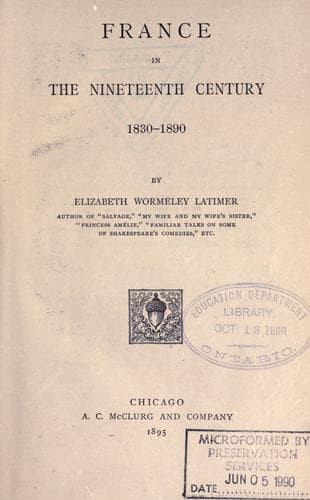
France in the Nineteenth CenturyLatimer, Elizabeth Wormeley
History
France in the Nineteenth Century
Latimer, Elizabeth Wormeley
France -- History -- 1789-1900
The Provisional Government, which was kept well informed as to
his movements, forwarded to him a supply of money. At Dreux the
king's party was joined by the Duke of Montpensier with news that
the king's attempt to save the monarchy by abdication had failed.
The old man seemed stupefied by his sudden fall. Over and over
again he was heard to repeat: "Comme Charles X.! Comme Charles X.!"
The next day, travelling under feigned names, the royal party pushed
on to Evreux, where they were hospitably received by a farmer in
the forest, who harnessed his work-horses to their carriage. Thence
they went on to their own Château d'Eu. The danger to which during
this journey they were exposed arose, not from the new Government
at Paris, but from the excited state of the peasantry.
After many perils and adventures, sometimes indeed travelling on
foot to avoid dangerous places, they reached Harfleur on March
3. An English steamer, the "Express," lay at the wharf, on which
the king and queen embarked as Mr. and Mrs. William Smith. The
following morning they were off the English coast, at Newbern.
They landed, and proceeded at once to Claremont, the palace given
to their son-in-law, Leopold of Belgium, for his lifetime by the
English Parliament.
The government set up in Paris was a provisional one. The members
of the Provisional Government were many of them well known to the
public, and of approved character. No men ever had a more difficult
task before them, and none ever tried with more self-sacrifice to
do their duty.
The measures they proposed were eighteen in number:
1. The retention of the tricolor.
2. The retention of the Gallic cock.
3. The sovereignty of the people.
4. The dissolution of the Chamber of Deputies.
5. The suppression of the Chamber of Peers.
6. The convocation of a National Assembly.
7. Work to be guaranteed to all working-men.
8. The unity of the army and the populace.
9. The formation of a Garde Mobile.
10. The arrest and punishment of all deserters.
11. The release of all political prisoners.
12. The trial of M. Guizot and his colleagues.
13. The reduction of Vincennes and Fort Valérien, still held by the
troops for the king.
14. All officials under Louis Philippe to be released from their oaths.
15. All objects at the Mont de Piété (the Government pawn-broking
establishment) valued under ten francs, to be restored.
16. All National Guards dismissed under preceding Governments to be
reinstated.
17. The million of francs expended on the court to be given to disabled
workmen.
18. A paternal commission to be nominated, to look after the interests
of the working-classes.
The institution of the Garde Mobile was a device for finding employment
for those boys and young men who formed one of the most dangerous
of the dangerous classes.
Public-domain text, read in full here on John Shaqi.
Reviews
Reviews
No reviews yet
Be the first to share your thoughts on this work.
Elsewhere in the archive
Join the Discussion
Join the discussion
Sign in to leave a comment or review.
Sign InorCreate an account