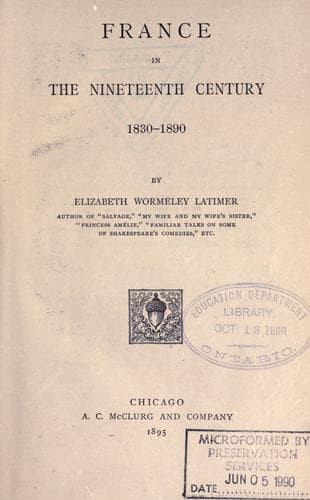
France in the Nineteenth CenturyLatimer, Elizabeth Wormeley
History
France in the Nineteenth Century
Latimer, Elizabeth Wormeley
France -- History -- 1789-1900
It is easy to see how tempting these promises were to working-men;
and yet the better class among them mourned their loss of steady
employment. The Revolution of 1848, though it was not originated
by the working-classes, was made to appear as if it were intended
for their profit; and that indeed was its ruin, for it was found
impossible to keep the promises of work, support, parental protection,
etc., made to the Parisian masses. The _bourgeoisie_, when they
recovered from their astonishment and found that the stone they
had set rolling under the name of reform had dislodged their own
Revolution of 1830, and the peasants of the provinces, when they
found that all the praise and all the profits were solely for the
working-men of the capital, were very far from satisfied.
As to the upper classes, their terror and dismay were overwhelming.
Everything seemed sliding away under their feet. Many women of rank
and fashion, distrusting the stability of the king's government, had
for some time past been yearly adding diamonds to their necklaces,
because, as one of them exclaimed to us during this month of February:
"We knew not what might happen to stocks or to securities, but
diamonds we can put into our pockets. No other property in France
can be called secure!"
And yet Paris soon resumed its wonted appearance. Commerce and
shopping might be impossible in a city where nobody could make
change for two hundred dollars, yet the Champs Elysées were again
gay with pedestrians and carriages. All favorite amusements were
resumed, but almost all men being idle, their great resource was
to assemble round the Hôtel-de-Ville and force Lamartine to make
a speech to them.
On Saturday, March 4, all Paris crowded to the Boulevards to witness
the funeral _cortège_ of the victims. There were neither military
nor police to keep order; yet the crowd was on its good behavior,
and strict decorum was maintained. There were about three hundred
thousand persons in the procession, and as many more on the sidewalks.
As they marched, mourners and spectators all sang the Chant of the
Girondins ("Mourir pour la Patrie") and the "Marseillaise."
Two things distinguished this revolution of February from all other
French revolutions before or after it,--the high character and
self-devotion of the men placed at the head of affairs, and the
absence of prejudice against religion. The revolution, so far from
putting itself in antagonism with religious feeling, everywhere
appealed to it. The men who invaded the Tuileries bowed before
the crucifix in the queen's chamber. Priests who were known to be
zealous workers among the poor were treated as fathers. _Curés_
blessed the trees of liberty planted in their parishes. Prayers for
the Republic were offered at the altars, and in country villages
priests headed the men of their congregations who marched up to
the polls.
[Illustration: _ALPHONSE DE LAMARTINE._]
CHAPTER VII.
LAMARTINE AND THE SECOND REPUBLIC.[1]
Public-domain text, read in full here on John Shaqi.
Reviews
Reviews
No reviews yet
Be the first to share your thoughts on this work.
Elsewhere in the archive
Join the Discussion
Join the discussion
Sign in to leave a comment or review.
Sign InorCreate an account