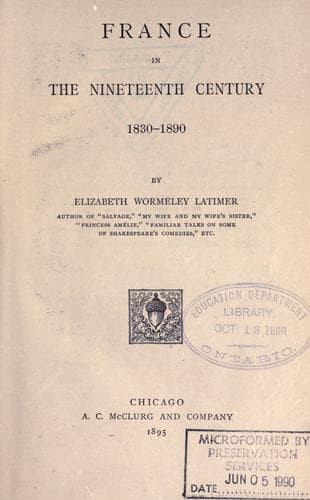
France in the Nineteenth CenturyLatimer, Elizabeth Wormeley
History
France in the Nineteenth Century
Latimer, Elizabeth Wormeley
France -- History -- 1789-1900
"In the midst of his manifold literary labors there happened to
Lamartine such a chance as befalls few poets. He had it in his
power, once in his life, to do something greater than the greatest
lyric, more noble than any verse. At the crisis of the Revolution
of 1848, chance (to use the word without irreverence) thrust him,
and no other, into the place of master, and held him for one supreme
moment alone between France and anarchy,--between, we might almost
say, the world and another terrible revolution. And then the
sentimentalist proved himself a man. He confronted raving Paris,
and subdued it. The old noble French blood in his veins rose to
the greatness of the crisis. With a pardonable thrill of pride
in a position so strange to a writer and a man of thought, into
which, without any action of his own, he found himself forced,
he describes how he faced the tumultuous mob of Paris for seventy
hours almost without repose, without sleep, without food, when
there was no other man in France bold enough or wise enough to
take that supreme part, and guide that most aimless of revolutions
to a peaceful conclusion,--for the moment, at least. It was not
Lamartine's fault that the Empire came after him. Long before the
Empire came, he had fallen from his momentary elevation, and lost
all influence with his country. But his downfall cannot efface the
fact that he did actually reign, and reign beneficently, subduing
and controlling the excited nation, saving men's lives and the
balance of society."
The seventy hours at the Hôtel-de-Ville to which Mrs. Oliphant
alludes were passed by Lamartine in making orations, in sending
off proclamations to the departments, in endeavoring to calm the
excited multitude and to secure the triumph of the Republic without
the effusion of blood. The revolution _he_ conducted was, if I may
say so, the only _respectable_ revolution France has ever known.
Nobody expected it, nobody was prepared for it, nobody worked for
it; but the whole country acquiesced in it, and men of all parties,
seeing that it was an accomplished fact, gave in their adhesion
to the Second Republic.
There were five great questions that came up before the Provisional
Government for immediate solution,--
The relation of France to foreign powers.
The enlargement of the army.
The subsistence of working-men out of employment.
The property and safety of the exiled royal family.
And, above all, how to meet these expenses and the payment of interest
on national bonds, due the middle of March, with assets in the
treasury of about twenty-five cents in the dollar.
These questions were all met by the wonderful energy of Lamartine
and his colleagues, seconded by genuine patriotic efforts throughout
France.
Public-domain text, read in full here on John Shaqi.
Reviews
Reviews
No reviews yet
Be the first to share your thoughts on this work.
Elsewhere in the archive
Join the Discussion
Join the discussion
Sign in to leave a comment or review.
Sign InorCreate an account