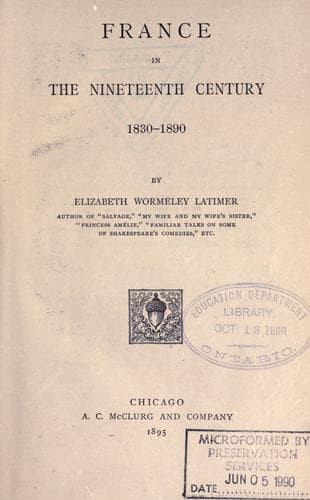
France in the Nineteenth CenturyLatimer, Elizabeth Wormeley
History
France in the Nineteenth Century
Latimer, Elizabeth Wormeley
France -- History -- 1789-1900
Lamartine had taken the foreign relations of the new Republic into
his own hands; and so well did he manage them that not one potentate
of Europe attempted to interfere with the internal affairs of France,
or to dispute the right of the French to establish a republic if
they thought proper. But although Lamartine's policy was peace,
he thought France needed a large army both to keep down communism
and anarchy at home, and to show itself strong in the face of all
foreign powers. The army of France in January, 1848, had been about
three hundred thousand men, of whom one hundred thousand were in
Algeria; by May it was five hundred thousand, not including the
Garde Mobile, which was of Lamartine's raising. It is well known
how fiercely boys and very young men fought when any occasion for
fighting was presented in the streets and at the barricades; all
business being stopped in Paris, thousands of these were out of
employment. Lamartine had them enrolled into his new corps, the
Garde Mobile. Their uniform at first was a red sash and a workman's
blouse. They were proud of themselves and of their new position,
and in May, by dint of discipline, they were transformed into a
fine soldierly body of very young men, who several times rendered
important help to the Government in maintaining the cause of order.
The National Guard was broken up until it could be reorganized,
and so was the Garde Municipale.
But how to feed the multitude? Two hundred thousand mechanics alone
were out of employment in Paris, besides laborers, servants, clerks,
etc. It was proposed to establish national workshops in Louis Philippe's
pretty private pleasure-grounds, the Parc des Monceaux. The men applying
for work were enrolled in squads; each squad had its banner and its
officers, and each man was paid on Saturday night his week's wages,
at the rate of two francs a day,--the highest wages in Paris at that
time for an artisan. There was no particular work for them to do,
but the arrangement kept them disciplined and out of mischief, though
at an enormous cost to the country. At the Palace of the Luxembourg
Louis Blanc was permitted to hold a series of great labor meetings,--a
sort of Socialist convention,--and to inveigh against "capitalists"
and "bloated bondholders" in a style that was much more novel then
than it is now. Lamartine greatly disapproved of these Luxembourg
proceedings; but he argued that it was better to countenance them
than to throw Louis Blanc and his friends into open opposition
to the Government. Louis Blanc was a charming writer, whose views
on social questions have made great progress since his day. His
brother Charles wrote a valuable book on art. He himself wrote a
"History of the Revolution" and the "History of Ten Years,"--that
is, from 1830 to 1840. He bitterly hated Louis Philippe and the
_bourgeoisie_, and yet his book is fair and honest, and the work of
a gentleman. He was almost a dwarf, but his face was very handsome,
Public-domain text, read in full here on John Shaqi.
Reviews
Reviews
No reviews yet
Be the first to share your thoughts on this work.
Elsewhere in the archive
Join the Discussion
Join the discussion
Sign in to leave a comment or review.
Sign InorCreate an account