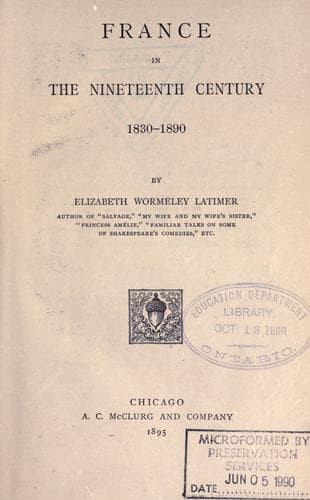
France in the Nineteenth CenturyLatimer, Elizabeth Wormeley
History
France in the Nineteenth Century
Latimer, Elizabeth Wormeley
France -- History -- 1789-1900
clean-shaved, with bright eyes and brown hair. I may remark _en
passant_ that not one of the members of the Provisional Government
wore either a beard or a moustache.
One of the first things the Provisional Government did was to decree
that the personal property of the Orleans family should not be
confiscated, but placed in the hands of a receiver, who should
pay the king and princes liberal allowances till it became certain
that their wealth would not be spent in raising an army for the
invasion of France.
Louis Philippe lived only two years after reaching England. They
were apparently not unhappy years to him. He sat at the foot of
his own table, and carved the joint daily for his guests, children,
and grandchildren. He dictated his Memoirs, and talked with the
greatest openness to those who wished to converse with him.
The Duc d'Aumale was head of the army in Algeria, and governor-general
of the colony, when the Revolution broke out. Here is the address
which he at once published to his soldiers and the people, and
with which the whole of his after life has been consistent:--
Inhabitants of Algeria! Faithful to my duties as a citizen and a
soldier, I have remained at my post as long as I could believe my
presence would be useful in the service of my country. It can no
longer be so. General Cavaignac is appointed governor-general of
Algeria, and until his arrival here, the functions of governor-general
_ad interim_ will be discharged by General Changarnier. Submissive
to the national will, I depart; but in my place of exile my best
prayers and wishes shall be for the prosperity and glory of France,
which I should have wished still longer to serve.
H. D'ORLÉANS.
The greatest problem which demanded solution from the Provisional
Government was how to make twenty-five cents do the work of a dollar.
The first Minister of Finance appointed, threw up his portfolio
in despair. Lamartine refused to sanction any arbitrary means of
raising money. At last, by giving some especial privileges and
protection to the Bank of France, and by mortgaging the national
forests, a sufficient sum was provided for immediate needs. The
people, too, throughout the provinces, made it a point of honor to
come forward and pay their taxes before they were due. The priests
preached this as a duty, for the priests were well disposed towards
the Revolution of 1848. Lamartine had put forth a proclamation
assuring priests and people that his Government was in sympathy
with religion.
Public-domain text, read in full here on John Shaqi.
Reviews
Reviews
No reviews yet
Be the first to share your thoughts on this work.
Elsewhere in the archive
Join the Discussion
Join the discussion
Sign in to leave a comment or review.
Sign InorCreate an account