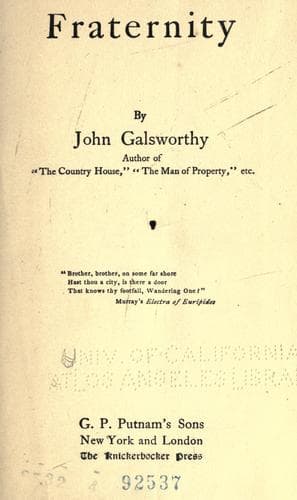
England -- Social life and customs -- 20th century -- Fiction; London (England) -- Fiction; Upper class families -- England -- Fiction
It was past nine when she turned into the Old Square, and rang the bell
of her sister's house with the sheer physical desire to rest--somewhere
that was not her home.
At one end of the long, low drawing-room Stephen, in evening dress, was
reading aloud from a review. Cecilia was looking dubiously at his sock,
where she seemed to see a tiny speck of white that might be Stephen. In
the window at the far end Thyme and Martin were exchanging speeches at
short intervals; they made no move at Bianca's entrance; and their faces
said: “We have no use for that handshaking nonsense!”
Receiving Cecilia's little, warm, doubting kiss and Stephen's polite,
dry handshake, Bianca motioned to him not to stop reading. He resumed.
Cecilia, too, resumed her scrutiny of Stephen's sock.
'Oh dear!' she thought. 'I know B.'s come here because she's unhappy.
Poor thing! Poor Hilary! It's that wretched business again, I suppose.'
Skilled in every tone of Stephen's voice, she knew that Bianca's entry
had provoked the same train of thought in him; to her he seemed reading
out these words: 'I disapprove--I disapprove. She's Cis's sister. But if
it wasn't for old Hilary I wouldn't have the subject in the house!'
Bianca, whose subtlety recorded every shade of feeling, could see that
she was not welcome. Leaning back with veil raised, she seemed listening
to Stephen's reading, but in fact she was quivering at the sight of
those two couples.
Couples, couples--for all but her! What crime had she committed? Why was
the china of her cup flawed so that no one could drink from it? Why had
she been made so that nobody could love her? This, the most bitter of
all thoughts, the most tragic of all questionings, haunted her.
The article which Stephen read--explaining exactly how to deal with
people so that from one sort of human being they might become another,
and going on to prove that if, after this conversion, they showed signs
of a reversion, it would then be necessary to know the reason why--fell
dryly on ears listening to that eternal question: Why is it with me
as it is? It is not fair!--listening to the constant murmuring of her
pride: I am not wanted here or anywhere. Better to efface myself!
From their end of the room Thyme and Martin scarcely looked at her. To
them she was Aunt B., an amateur, the mockery of whose eyes sometimes
penetrated their youthful armour; they were besides too interested in
their conversation to perceive that she was suffering. The skirmish of
that conversation had lasted now for many days--ever since the death of
the Hughs' baby.
“Well,” Martin was saying, “what are you going to do? It's no good to
base it on the baby; you must know your own mind all round. You can't go
rushing into real work on mere sentiment.”
“You went to the funeral, Martin. It's bosh to say you didn't feel it
too!”
Martin deigned no answer to this insinuation.
Public-domain text, read in full here on John Shaqi.
Reviews
Reviews
No reviews yet
Be the first to share your thoughts on this work.
Elsewhere in the archive
Join the Discussion
Join the discussion
Sign in to leave a comment or review.
Sign InorCreate an account