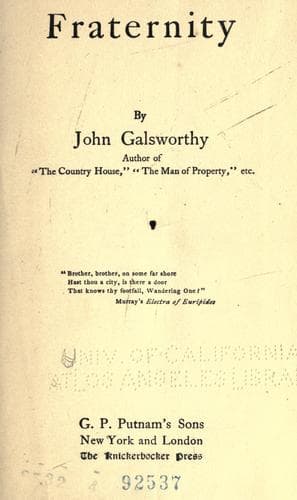
England -- Social life and customs -- 20th century -- Fiction; London (England) -- Fiction; Upper class families -- England -- Fiction
“We've gone past the need for sentiment,” he said: “it's exploded; so is
Justice, administered by an upper class with a patch over one eye and a
squint in the other. When you see a dying donkey in a field, you don't
want to refer the case to a society, as your dad would; you don't want
an essay of Hilary's, full of sympathy with everybody, on 'Walking in a
field: with reflections on the end of donkeys'--you want to put a bullet
in the donkey.”
“You're always down on Uncle Hilary,” said Thyme.
“I don't mind Hilary himself; I object to his type.”
“Well, he objects to yours,” said Thyme.
“I'm not so sure of that,” said Martin slowly; “he hasn't got character
enough.”
Thyme raised her chin, and, looking at him through half-closed eyes,
said: “Well, I do think, of all the conceited persons I ever met you're
the worst.”
Martin's nostril curled.
“Are you prepared,” he said, “to put a bullet in the donkey, or are you
not?”
“I only see one donkey, and not a dying one!”
Martin stretched out his hand and gripped her arm below the elbow.
Retaining it luxuriously, he said: “Don't wander!”
Thyme tried to free her arm. “Let go!”
Martin was looking straight into her eyes. A flush had risen in his
cheeks.
Thyme, too, went the colour of the old-rose curtain behind which she
sat.
“Let go!”
“I won't! I'll make you know your mind. What do you mean to do? Are you
coming in a fit of sentiment, or do you mean business?”
Suddenly, half-hypnotised, the young girl ceased to struggle. Her face
had the strangest expression of submission and defiance--a sort of
pain, a sort of delight. So they sat full half a minute staring at each
other's eyes. Hearing a rustling sound, they looked, and saw Bianca
moving to the door. Cecilia, too, had risen.
“What is it, B.?”
Bianca, opening the door, went out. Cecilia followed swiftly, too late
to catch even a glimpse of her sister's face behind the veil...
In Mr. Stone's room the green lamp burned dimly, and he who worked by it
was sitting on the edge of his campbed, attired in his old brown woollen
gown and slippers.
And suddenly it seemed to him that he was not alone.
“I have finished for to-night,” he said. “I am waiting for the moon to
rise. She is nearly full; I shall see her face from here.”
A form sat down by him on the bed, and a voice said softly:
“Like a woman's.”
Mr. Stone saw his younger daughter. “You have your hat on. Are you going
out, my dear?”
“I saw your light as I came in.”
“The moon,” said Mr. Stone, “is an arid desert. Love is unknown there.”
“How can you bear to look at her, then?” Bianca whispered.
Mr. Stone raised his finger. “She has risen.”
The wan moon had slipped out into the darkness. Her light stole across
the garden and through the open window to the bed where they were
sitting.
“Where there is no love, Dad,” Bianca said, “there can be no life, can
there?”
Mr. Stone's eyes seemed to drink the moonlight.
“That,” he said, “is the great truth. The bed is shaking!”
Public-domain text, read in full here on John Shaqi.
Reviews
Reviews
No reviews yet
Be the first to share your thoughts on this work.
Elsewhere in the archive
Join the Discussion
Join the discussion
Sign in to leave a comment or review.
Sign InorCreate an account