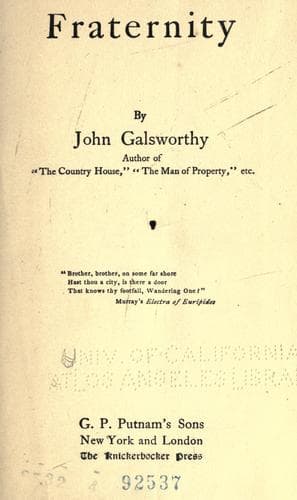
England -- Social life and customs -- 20th century -- Fiction; London (England) -- Fiction; Upper class families -- England -- Fiction
Educated at a public school and Cambridge, blessed with competent,
though not large, independent incomes, and brought up never to allude to
money if it could possibly be helped, the two young men had been turned
out of the mint with something of the same outward stamp on them. Both
were kindly, both fond of open-air pursuits, and neither of them lazy.
Both, too, were very civilised, with that bone-deep decency, that
dislike of violence, nowhere so prevalent as in the upper classes of a
country whose settled institutions are as old as its roads, or the walls
which insulate its parks. But as time went on, the one great quality
which heredity and education, environment and means, had bred in both of
them--self-consciousness--acted in these two brothers very differently.
To Stephen it was preservative, keeping him, as it were, in ice
throughout hot-weather seasons, enabling him to know exactly when he was
in danger of decomposition, so that he might nip the process in the
bud; it was with him a healthy, perhaps slightly chemical, ingredient,
binding his component parts, causing them to work together safely,
homogeneously. In Hilary the effect seemed to have been otherwise; like
some slow and subtle poison, this great quality, self-consciousness,
had soaked his system through and through; permeated every cranny of his
spirit, so that to think a definite thought, or do a definite deed, was
obviously becoming difficult to him. It took in the main the form of a
sort of gentle desiccating humour.
“It's a remarkable thing,” he had one day said to Stephen, “that by the
process of assimilating little bits of chopped-up cattle one should be
able to form the speculation of how remarkable a thing it is.”
Stephen had paused a second before answering--they were lunching off
roast beef in the Law Courts--he had then said:
“You're surely not going to eschew the higher mammals, like our
respected father-in-law?”
“On the contrary,” said Hilary, “to chew them; but it is remarkable, for
all that; you missed my point.”
It was clear that a man who could see anything remarkable in such a
thing was far gone, and Stephen had murmured:
“My dear old chap, you're getting too introspective.”
Hilary, having given his brother the special retiring smile, which
seemed not only to say; “Don't let me bore you,” but also, “Well,
perhaps you had better wait outside,” the conversation closed.
Public-domain text, read in full here on John Shaqi.
Reviews
Reviews
No reviews yet
Be the first to share your thoughts on this work.
Join the Discussion
Join the discussion
Sign in to leave a comment or review.
Sign InorCreate an account