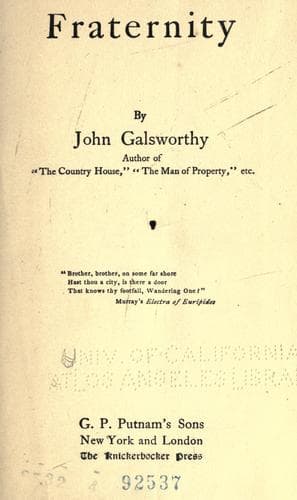
England -- Social life and customs -- 20th century -- Fiction; London (England) -- Fiction; Upper class families -- England -- Fiction
And, taking his time, he cleared his throat in preparation for speech.
But before the singular muteness of this family sounds would not come.
Finishing his tea, he tremblingly arose. Things that he might have said
jostled in his mind. 'Very pleased to 'a seen you. Hope you're in good
health at the present time of speaking. Don't let me intrude on you.
We've all a-got to die some time or other!' They remained unuttered.
Making a vague movement of his skinny hand, he walked feebly but quickly
to the door. When he stood but half-way within the room, he made his
final effort.
“I'm not a-goin' to say nothing,” he said; “that'd be superlative! I
wish you a good-morning.”
Outside he waited a second, then grasped the banister.
'For all he sets so quiet, they've done him no good in that place,' he
thought. 'Them eyes of his!' And slowly he descended, full of a sort of
very deep surprise. 'I misjudged of him,' he was thinking; 'he never
was nothing but a 'armless human being. We all has our predijuices--I
misjudged of him. They've broke his 'eart between 'em--that they have.'
The silence in the room continued after his departure. But when the
little boy had gone to school, Hughs rose and lay down on the bed. He
rested there, unmoving, with his face towards the wall, his arms
clasped round his head to comfort it. The seamstress, stealing about her
avocations, paused now and then to look at him. If he had raged at her,
if he had raged at everything, it would not have been so terrifying as
this utter silence, which passed her comprehension--this silence as of
a man flung by the sea against a rock, and pinned there with the life
crushed out of him. All her inarticulate longing, now that her baby
was gone, to be close to something in her grey life, to pass the
unfranchisable barrier dividing her from the world, seemed to well up,
to flow against this wall of silence and to recoil.
Twice or three times she addressed him timidly by name, or made some
trivial remark. He did not answer, as though in very truth he had been
the shadow of a man lying there. And the injustice of this silence
seemed to her so terrible. Was she not his wife? Had she not borne him
five, and toiled to keep him from that girl? Was it her fault if she had
made his life a hell with her jealousy, as he had cried out that morning
before he went for her, and was “put away”? He was her “man.” It had
been her right--nay, more, her duty!
Public-domain text, read in full here on John Shaqi.
Reviews
Reviews
No reviews yet
Be the first to share your thoughts on this work.
Elsewhere in the archive
Join the Discussion
Join the discussion
Sign in to leave a comment or review.
Sign InorCreate an account