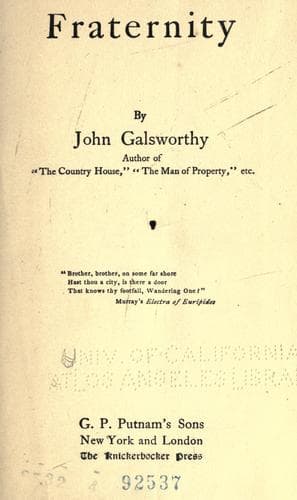
England -- Social life and customs -- 20th century -- Fiction; London (England) -- Fiction; Upper class families -- England -- Fiction
And still he lay there silent. From the narrow street where no traffic
passed, the cries of a coster and distant whistlings mounted through the
unwholesome air. Some sparrows in the eave were chirruping incessantly.
The little sandy house-cat had stolen in, and, crouched against the
doorpost, was fastening her eyes on the plate which, held the remnants
of the fish. The seamstress bowed her forehead to the flowers on the
table; unable any longer to bear the mystery of this silence, she wept.
But the dark figure on the bed only pressed his arms closer round his
head, as though there were within him a living death passing the speech
of men.
The little sandy cat, creeping across the floor, fixed its claws in the
backbone of the fish, and drew it beneath the bed.
CHAPTER XXXIX
THE DUEL
Bianca did not see her husband after their return together from the
Round Pond. She dined out that evening, and in the morning avoided any
interview. When Hilary's luggage was brought down and the cab summoned,
she slipped up to take shelter in her room. Presently the sound of his
footsteps coming along the passage stopped outside her door. He tapped.
She did not answer.
Good-bye would be a mockery! Let him go with the words unsaid! And as
though the thought had found its way through the closed door, she heard
his footsteps recede again. She saw him presently go out to the cab with
his head bent down, saw him stoop and pat Miranda. Hot tears sprang into
her eyes. She heard the cab-wheels roll away.
The heart is like the face of an Eastern woman--warm and glowing, behind
swathe on swathe of fabric. At each fresh touch from the fingers of
Life, some new corner, some hidden curve or angle, comes into view, to
be seen last of all perhaps never to be seen by the one who owns them.
When the cab had driven away there came into Bianca's heart a sense of
the irreparable, and, mysteriously entwined with that arid ache, a sort
of bitter pity: What would happen to this wretched girl now that he was
gone? Would she go completely to the bad--till she became one of those
poor creatures like the figure in “The Shadow,” who stood beneath
lampposts in the streets? Out of this speculation, which was bitter as
the taste of aloes, there came to her a craving for some palliative,
some sweetness, some expression of that instinct of fellow-feeling deep
in each human breast, however disharmonic. But even with that craving
was mingled the itch to justify herself, and prove that she could rise
above jealousy.
She made her way to the little model's lodging.
A child admitted her into the bleak passage that served for hall. The
strange medley of emotions passing through Bianca's breast while she
stood outside the girl's door did not show in her face, which wore its
customary restrained, half-mocking look.
The little model's voice faintly said: “Come in.”
Public-domain text, read in full here on John Shaqi.
Reviews
Reviews
No reviews yet
Be the first to share your thoughts on this work.
Elsewhere in the archive
Join the Discussion
Join the discussion
Sign in to leave a comment or review.
Sign InorCreate an account