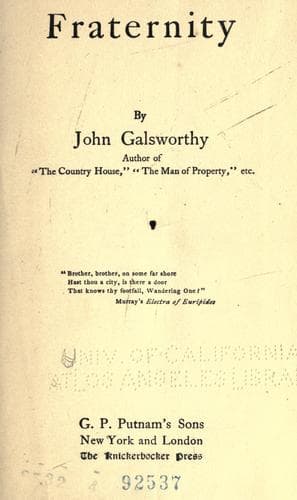
England -- Social life and customs -- 20th century -- Fiction; London (England) -- Fiction; Upper class families -- England -- Fiction
It was his business to know all the passers-by, and his pleasure too;
his mind was thus distracted from the condition of his feet. He knew
this particular lady with the delicate face, and found her puzzling;
she sometimes bought the paper which Fate condemned him, against his
politics, to sell. The Tory journals were undoubtedly those which her
class of person ought to purchase. He knew a lady when he saw one. In
fact, before Life threw him into the streets, by giving him a disease in
curing which his savings had disappeared, he had been a butler, and for
the gentry had a respect as incurable as was his distrust of “all
that class of people” who bought their things at “these 'ere large
establishments,” and attended “these 'ere subscription dances at the
Town 'All over there.” He watched her with special interest, not,
indeed, attempting to attract attention, though conscious in every fibre
that he had only sold five copies of his early issues. And he was sorry
and surprised when she passed from his sight through one of the hundred
doors.
The thought which spurred her into Messrs. Rose and Thorn's was this: “I
am thirty-eight; I have a daughter of seventeen. I cannot afford to
lose my husband's admiration. The time is on me when I really must make
myself look nice!”
Before a long mirror, in whose bright pool there yearly bathed hundreds
of women's bodies, divested of skirts and bodices, whose unruffled
surface reflected daily a dozen women's souls divested of everything,
her eyes became as bright as steel; but having ascertained the need of
taking two inches off the chest of the gentian frock, one off its waist,
three off its hips, and of adding one to its skirt, they clouded again
with doubt, as though prepared to fly from the decision she had come to.
Resuming her bodice, she asked:
“When could you let me have it?”
“At the end of the week, madam.”
“Not till then?”
“We are very pressed, madam.”
“Oh, but you must let me have it by Thursday at the latest, please.”
The fitter sighed: “I will do my best.”
“I shall rely on you. Mrs. Stephen Dallison, 76, The Old Square.”
Going downstairs she thought: “That poor girl looked very tired; it's a
shame they give them such long hours!” and she passed into the street.
A voice said timidly behind her: “Westminister, marm?”
“That's the poor old creature,” thought Cecilia Dallison, “whose nose is
so unpleasant. I don't really think I--” and she felt for a penny in her
little bag. Standing beside the “poor old creature” was a woman clothed
in worn but neat black clothes, and an ancient toque which had once
known a better head. The wan remains of a little bit of fur lay round
her throat. She had a thin face, not without refinement, mild, very
clear brown eyes, and a twist of smooth black hair. Beside her was
a skimpy little boy, and in her arms a baby. Mrs. Dallison held out
two-pence for the paper, but it was at the woman that she looked.
Public-domain text, read in full here on John Shaqi.
Reviews
Reviews
No reviews yet
Be the first to share your thoughts on this work.
Join the Discussion
Join the discussion
Sign in to leave a comment or review.
Sign InorCreate an account