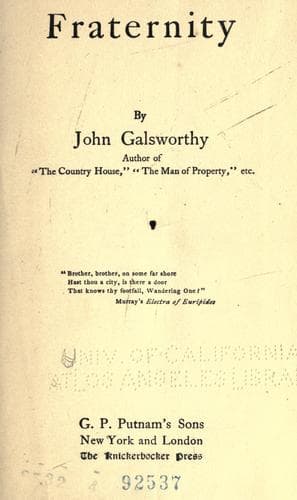
England -- Social life and customs -- 20th century -- Fiction; London (England) -- Fiction; Upper class families -- England -- Fiction
Hilary's tall thin figure appearing in the open doorway of the top-floor
front, his kind and worried face, and the pale agate eyes of the little
bulldog peeping through his legs, were witnessed by nothing but a baby,
who was sitting in a wooden box in the centre of the room. This baby,
who was very like a piece of putty to which Nature had by some accident
fitted two movable black eyes, was clothed in a woman's knitted
undervest, spreading beyond his feet and hands, so that nothing but
his head was visible. This vest divided him from the wooden shavings on
which he sat, and, since he had not yet attained the art of rising
to his feet, the box divided him from contacts of all other kinds. As
completely isolated from his kingdom as a Czar of all the Russias, he
was doing nothing. In this realm there was a dingy bed, two chairs, and
a washstand, with one lame leg, supported by an aged footstool. Clothes
and garments were hanging on nails, pans lay about the hearth, a
sewing-machine stood on a bare deal table. Over the bed was hung an
oleograph, from a Christmas supplement, of the birth of Jesus, and above
it a bayonet, under which was printed in an illiterate hand on a rough
scroll of paper: “Gave three of em what for at Elandslaagte. S. Hughs.”
Some photographs adorned the walls, and two drooping ferns stood on the
window-ledge. The room withal had a sort of desperate tidiness; in a
large cupboard, slightly open, could be seen stowed all that must not
see the light of day. The window of the baby's kingdom was tightly
closed; the scent was the scent of walls and washing and red herrings,
and--of other things.
Hilary looked at the baby, and the baby looked at him. The eyes of that
tiny scrap of grey humanity seemed saying:
'You are not my mother, I believe?'
He stooped down and touched its cheek. The baby blinked its black eyes
once.
'No,' it seemed, to say again, 'you are not my mother.'
A lump rose in Hilary's throat; he turned and went downstairs. Pausing
outside the little model's door, he knocked, and, receiving no answer,
turned the handle. The little square room was empty; it was neat and
clean enough, with a pink-flowered paper of comparatively modern date.
Through its open window could be seen a pear-tree in full bloom. Hilary
shut the door again with care, ashamed of having opened it.
On the half-landing, staring up at him with black eyes like the baby's,
was a man of medium height and active build, whose short face, with
broad cheekbones, cropped dark hair, straight nose, and little black
moustache, was burnt a dark dun colour. He was dressed in the uniform
of those who sweep the streets--a loose blue blouse, and trousers tucked
into boots reaching half-way up his calves; he held a peaked cap in his
hand.
After some seconds of mutual admiration, Hilary said:
“Mr. Hughs, I believe?” Yes.
“I've been up to see your wife.”
“Have you?”
“You know me, I suppose?”
“Yes, I know you.”
Public-domain text, read in full here on John Shaqi.
Reviews
Reviews
No reviews yet
Be the first to share your thoughts on this work.
Join the Discussion
Join the discussion
Sign in to leave a comment or review.
Sign InorCreate an account