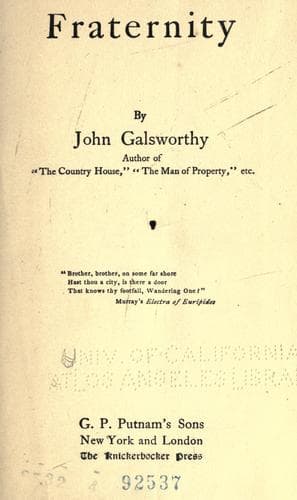
England -- Social life and customs -- 20th century -- Fiction; London (England) -- Fiction; Upper class families -- England -- Fiction
All that was like the little Persian kitten within Cecilia--cosiness
and love of pretty things, attachment to her own abode with its
high-art lining, love for her mate and her own kitten, Thyme, dread of
disturbance--all made her long to push this woman from the room; this
woman with the skimpy figure, and eyes that, for all their patience, had
in them something virago-like; this woman who carried about with her an
atmosphere of sordid grief, of squalid menaces, and scandal. She
longed all the more because it could well be seen from the seamstress's
helpless attitude that she too would have liked an easy life. To dwell
on things like this was to feel more than thirty-eight!
Cecilia had no pocket, Providence having removed it now for some time
past, but from her little bag she drew forth the two essentials of
gentility. Taking her nose, which she feared was shining, gently within
one, she fumbled in the other. And again she looked doubtfully at Mrs.
Hughs. Her heart said: 'Give the poor woman half a sovereign; it might
comfort her!' But her brain said: 'I owe her four-and-six; after what
she's just been saying about her husband and that girl and Hilary, it
mayn't be safe to give her more.' She held out two half-crowns, and had
an inspiration: “I shall mention to my sister what you've said; you can
tell your husband that!”
No sooner had she said this, however, than she saw, from a little smile
devoid of merriment and quickly extinguished, that Mrs. Hughs did not
believe she would do anything of the kind; from which she concluded that
the seamstress was convinced of Hilary's interest in the little model.
She said hastily:
“You can go now, Mrs. Hughs.”
Mrs. Hughs went, making no noise or sign of any sort.
Cecilia returned to her scattered thoughts. They lay there still, with
a gleam of sun from the low window smearing their importance; she felt
somehow that it did not now matter very much whether she and Stephen, in
the interests of science, saw that man fall from his balloon, or, in
the interests of art, heard Herr von Kraaffe sing his Polish songs; she
experienced, too, almost a revulsion in favour of tinned milk. After
meditatively tearing up her note to Messrs. Rose and Thorn, she lowered
the bureau lid and left the room.
Mounting the stairs, whose old oak banisters on either side were a real
joy, she felt she was stupid to let vague, sordid rumours, which,
after all, affected her but indirectly, disturb her morning's work. And
entering Stephen's dressing-room she stood looking at his boots.
Inside each one of them was a wooden soul; none had any creases, none
had any holes. The moment they wore out, their wooden souls were taken
from them and their bodies given to the poor, whilst--in accordance with
that theory, to hear a course of lectures on which a scattered thought
was even now inviting her--the wooden souls migrated instantly to other
leathern bodies.
Public-domain text, read in full here on John Shaqi.
Reviews
Reviews
No reviews yet
Be the first to share your thoughts on this work.
Join the Discussion
Join the discussion
Sign in to leave a comment or review.
Sign InorCreate an account