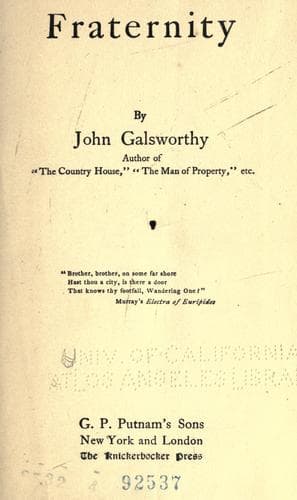
England -- Social life and customs -- 20th century -- Fiction; London (England) -- Fiction; Upper class families -- England -- Fiction
Cecilia looked about her; she had not been inside her father's room for
several months. There was nothing in it but that desk, a camp bed in the
far corner (with blankets, but no sheets), a folding washstand, and a
narrow bookcase, the books in which Cecilia unconsciously told off on
the fingers of her memory. They never varied. On the top shelf the Bible
and the works of Plautus and Diderot; on the second from the top the
plays of Shakespeare in a blue edition; on the third from the bottom Don
Quixote, in four volumes, covered with brown paper; a green Milton; the
“Comedies of Aristophanes”; a leather book, partially burned, comparing
the philosophy of Epicurus with the philosophy of Spinoza; and in a
yellow binding Mark Twain's “Huckleberry Finn.” On the second from
the bottom was lighter literature: “The Iliad”; a “Life of Francis of
Assisi”; Speke's “Discovery of the Sources of the Nile”; the “Pickwick
Papers”; “Mr. Midshipman Easy”; The Verses of Theocritus, in a very
old translation; Renan's “Life of Christ”; and the “Autobiography of
Benvenuto Cellini.” The bottom shelf of all was full of books on natural
science.
The walls were whitewashed, and, as Cecilia knew, came off on anybody
who leaned against them. The floor was stained, and had no carpet. There
was a little gas cooking-stove, with cooking things ranged on it; a
small bare table; and one large cupboard. No draperies, no pictures,
no ornaments of any kind; but by the window an ancient golden leather
chair. Cecilia could never bear to sit in that oasis; its colour in this
wilderness was too precious to her spirit.
“It's an east wind, father; aren't you terribly cold without a fire?”
Mr. Stone came from his writing-desk, and stood so that light might fall
on a sheet of paper in his hand. Cecilia noted the scent that went about
with him of peat and baked potatoes. He spoke:
“Listen to this: 'In the condition of society, dignified in those
days with the name of civilisation, the only source of hope was
the persistence of the quality called courage. Amongst a thousand
nerve-destroying habits, amongst the dramshops, patent medicines, the
undigested chaos of inventions and discoveries, while hundreds were
prating in their pulpits of things believed in by a negligible fraction
of the population, and thousands writing down today what nobody would
want to read in two days' time; while men shut animals in cages, and
made bears jig to please their children, and all were striving one
against the other; while, in a word, like gnats above a stagnant pool on
a summer's evening, man danced up and down without the faintest notion
why--in this condition of affairs the quality of courage was alive.
It was the only fire within that gloomy valley.'” He stopped, though
evidently anxious to go on, because he had read the last word on that
sheet of paper. He moved towards the writing-desk. Cecilia said hastily:
“Do you mind if I shut the window, father?”
Public-domain text, read in full here on John Shaqi.
Reviews
Reviews
No reviews yet
Be the first to share your thoughts on this work.
Join the Discussion
Join the discussion
Sign in to leave a comment or review.
Sign InorCreate an account