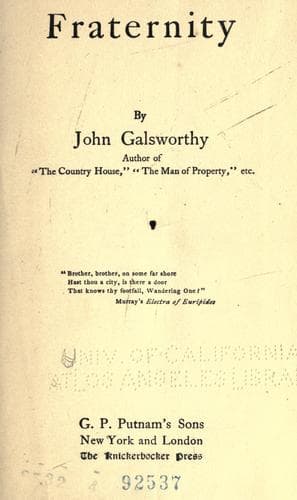
England -- Social life and customs -- 20th century -- Fiction; London (England) -- Fiction; Upper class families -- England -- Fiction
The tide of life was flowing in the town. The streets were awash with
wave on wave of humanity, sucked into a thousand crossing currents.
Here men and women were streaming out from the meeting of a religious
congress, there streaming in at the gates of some social function; like
bright water confined within long shelves of rock and dyed with myriad
scales of shifting colour, they thronged Rotten Row, and along the
closed shop-fronts were woven into an inextricable network of little
human runlets. And everywhere amongst this sea of men and women could
be seen their shadows, meandering like streaks of grey slime stirred
up from the lower depths by some huge, never-ceasing finger. The
innumerable roar of that human sea climbed out above the roofs and
trees, and somewhere in illimitable space blended, and slowly reached
the meeting-point of sound and silence--that Heart where Life, leaving
its little forms and barriers, clasps Death, and from that clasp springs
forth new-formed, within new barriers.
Above this crowd of his fellow-creatures, Stephen drove, and the same
Spring wind which had made the elm-trees talk, whispered to him, and
tried to tell him of the million flowers it had fertilised, the million
leaves uncurled, the million ripples it had awakened on the sea, of the
million flying shadows flung by it across the Downs, and how into men's
hearts its scent had driven a million longings and sweet pains.
It was but moderately successful, for Stephen, like all men of culture
and neat habits, took Nature only at those moments when he had gone out
to take her, and of her wild heart he had a secret fear.
On his own doorstep he encountered Hilary coming out.
“I ran across Thyme and Martin in the Gardens,” the latter said. “Thyme
brought me back to lunch, and here I've been ever since.”
“Did she bring our young Sanitist in too?” asked Stephen dubiously.
“No,” said Hilary.
“Good! That young man gets on my nerves.” Taking his elder brother by
the arm, he added: “Will you come in again, old boy, or shall we go for
a stroll?”
“A stroll,” said Hilary.
Though different enough, perhaps because they were so different, these
two brothers had the real affection for each other which depends on
something deeper and more elementary than a similarity of sentiments,
and is permanent because unconnected with the reasoning powers.
It depended on the countless times they had kissed and wrestled as tiny
boys, slept in small beds alongside, refused-to “tell” about each other,
and even now and then taken up the burden of each other's peccadilloes.
They might get irritated or tired of being in each other's company, but
it would have been impossible for either to have been disloyal to the
other in any circumstances, because of that traditional loyalty which
went back to their cribs.
Preceded by Miranda, they walked along the flower walk towards the Park,
talking of indifferent things, though in his heart each knew well enough
what was in the other's.
Public-domain text, read in full here on John Shaqi.
Reviews
Reviews
No reviews yet
Be the first to share your thoughts on this work.
Elsewhere in the archive
Join the Discussion
Join the discussion
Sign in to leave a comment or review.
Sign InorCreate an account