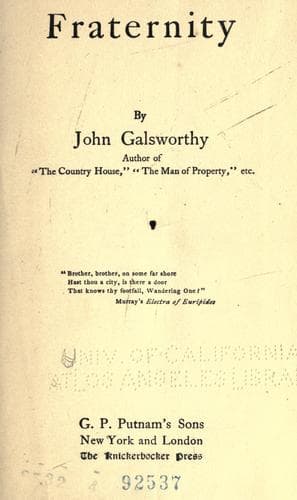
England -- Social life and customs -- 20th century -- Fiction; London (England) -- Fiction; Upper class families -- England -- Fiction
Stephen broke through the hedge.
“Cis has been telling me,” he said, “that this man Hughs is making
trouble of some sort.”
Hilary nodded.
Stephen glanced a little anxiously at his brother's face; it struck him
as looking different, neither so gentle nor so impersonal as usual.
“He's a ruffian, isn't he?”
“I can't tell you,” Hilary answered. “Probably not.”
“He must be, old chap,” murmured Stephen. Then, with a friendly pressure
of his brother's arm, he added: “Look here, old boy, can I be of any
use?”
“In what?” asked Hilary.
Stephen took a hasty mental view of his position; he had been in danger
of letting Hilary see that he suspected him. Frowning slightly, and with
some colour in his clean-shaven face, he said:
“Of course, there's nothing in it.”
“In what?” said Hilary again.
“In what this ruffian says.”
“No,” said Hilary, “there's nothing in it, though what there may be if
people give me credit for what there isn't, is another thing.”
Stephen digested this remark, which hurt him. He saw that his suspicions
had been fathomed, and this injured his opinion of his own diplomacy.
“You mustn't lose your head, old man,” he said at last.
They were crossing the bridge over the Serpentine. On the bright waters,
below, young clerks were sculling their inamoratas up and down; the
ripples set free by their oars gleamed beneath the sun, and ducks swam
lazily along the banks. Hilary leaned over.
“Look here, Stephen, I take an interest in this child--she's a helpless
sort of little creature, and she seems to have put herself under my
protection. I can't help that. But that's all. Do you understand?”
This speech produced a queer turmoil in Stephen, as though his brother
had accused him of a petty view of things. Feeling that he must justify
himself somehow, he began:
“Oh, of course I understand, old boy! But don't think, anyway, that I
should care a damn--I mean as far as I'm concerned--even if you had gone
as far as ever you liked, considering what you have to put up with. What
I'm thinking of is the general situation.”
By this clear statement of his point of view Stephen felt he had put
things back on a broad basis, and recovered his position as a man of
liberal thought. He too leaned over, looking at the ducks. There was a
silence. Then Hilary said:
“If Bianca won't get that child into some fresh place, I shall.”
Stephen looked at his brother in surprise, amounting almost to dismay;
he had spoken with such unwonted resolution.
“My dear old chap,” he said, “I wouldn't go to B. Women are so funny.”
Hilary smiled. Stephen took this for a sign of restored impersonality.
“I'll tell you exactly how the thing appeals to me. It'll be much better
for you to chuck it altogether. Let Cis see to it!”
Hilary's eyes became bright with angry humour.
“Many thanks,” he said, “but this is entirely our affair.”
Stephen answered hastily:
Public-domain text, read in full here on John Shaqi.
Reviews
Reviews
No reviews yet
Be the first to share your thoughts on this work.
Elsewhere in the archive
Join the Discussion
Join the discussion
Sign in to leave a comment or review.
Sign InorCreate an account