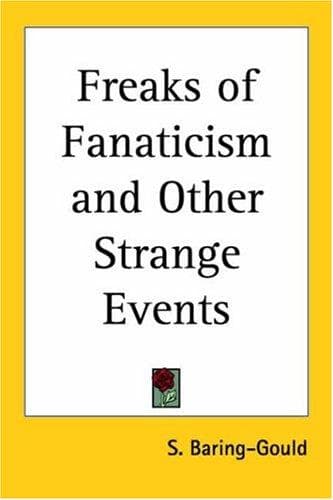
Freaks of Fanaticism, and Other Strange EventsBaring-Gould, S. (Sabine)
Religion
Freaks of Fanaticism, and Other Strange Events
Baring-Gould, S. (Sabine)
History; Mysticism; Patarines
[238] Luth. "Sämmtliche Werke," Wittenb. 1545-51, ii. ff.
367-375; "Von der Teuffelischen Secte d. Widerteuffer. zu
Münster."
[239] _Ibid._ f. 367.
"What shall I say? You let all the world see that you understand far
less about the kingdom of Christ than did the Jews, who blame you
for your want of understanding, and yet none spoke or believed more
ignorantly of that same kingdom than they. For the Scripture and the
prophets point to Messiah, through whom all was to be fulfilled, and
this the Jews also believed. But you want to make it point to your
Tailor-King, to the great disgrace and mockery of Christ, our only
true King, Saviour, and Redeemer."[240]
[240] _Ibid._ f. 369.
But this was the grievous rub with the Reformer--that the Anabaptist
had gone a step beyond himself. "You have cast away all that Dr.
Martin Luther taught you, and yet it is from him that you have
received, next to God, all sound learning out of the Scripture; you
have given another definition of faith, after your new fashion, with
various additional articles, so that you have not only darkened, but
have utterly annihilated the value of saving faith."[241]
[241] _Ibid._ f. 373.
In a treatise of Justus Menius, published with Luther's approval,
and with a preface by him, "On the Spirit of the Anabaptists,"
it is angrily complained, that these sectaries bring against the
Lutheran Church the following charges:--"First, that our churches
are idol-temples, since God dwelleth not in temples made with hands.
Secondly, that we do not preach the truth, and have true Divine
worship therein. Thirdly, that our preachers are sinners, and are
therefore unfit to teach others. Fourthly, that the common people
do not mend their morals by our preaching." All which charges
Justus Menius answers as well as he can, sword in one hand against
the Papists, trowel in the other patching up the walls of his
Jerusalem.[242]
[242] _Ibid._ ii. ff. 298-325.
Melancthon also wrote against the Anabaptist book, combating all its
propositions, and to do so falling back on the maxim, _Abusus non
tollit substantiam_, a maxim completely ignored by the Reformers
when they attacked the Catholics.[243] Thus the new sect fought
Lutheranism with precisely the same weapons wherewith the Lutherans
had fought the Church; and the Lutherans, to maintain their
ground, were obliged to take refuge in the authority of the Church
and tradition--positions they had assailed formerly, and to use
arguments they had previously rejected.
[243] _Ibid._ ii. ff. 334-363. Melancthon says that things had
come to such a pass in Münster, that no child knew who was its
father, brother, or sister.
In the treatise of the five Hessian divines, drawn up by Philip of
Hesse's orders, the errors of the Anabaptists are epitomised and
condemned; they are as follows:--
"1. They do not believe that men are justified
by faith only, but by faith and works conjointly.
Public-domain text, read in full here on John Shaqi.
Reviews
Reviews
No reviews yet
Be the first to share your thoughts on this work.
Elsewhere in the archive
Join the Discussion
Join the discussion
Sign in to leave a comment or review.
Sign InorCreate an account