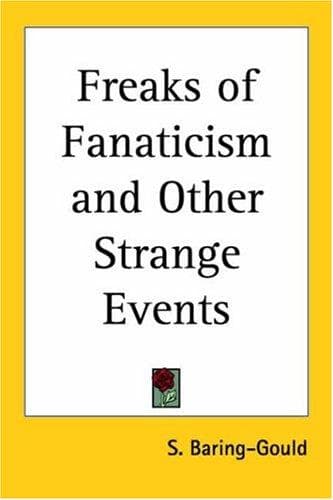
Freaks of Fanaticism, and Other Strange EventsBaring-Gould, S. (Sabine)
Religion
Freaks of Fanaticism, and Other Strange Events
Baring-Gould, S. (Sabine)
History; Mysticism; Patarines
2. They refer the redemption of Christ alone to the fall of
Adam, and to its consequences on those born of him.
3. They hold community of goods.
4. They blame Martin Luther as having taught nothing about good
works.
5. They proclaim the freedom of man's will.
6. They reject infant baptism.
7. They take the Bible alone, uninterpreted by any commentary.
8. They declare for plurality of wives.
9. They do not correctly teach the Incarnation of Christ."[244]
[244] "Acta Handlung." &c. f. 366 a.
This "Kurtze: und in der eile gestelte Antwort," is signed by
John Campis, John Fontius, John Kymeus, John Lessing, and Anthony
Corvinus.
It was high time that the siege should come to an end, so every one
said; but every one had said the same for the last twelve months,
and Münster held out notwithstanding.
An ultimatum was sent into the city by the general in command,
offering the inhabitants liberal terms if they would surrender, and
warning them that, in case of refusal, the city would be taken by
storm, and would be delivered over to plunder.[245] No answer was
made to the letter; nevertheless, it produced a profound impression
on the citizens, who were already suffering from want of victuals. A
party was formed which resolved to seize the person of the king, and
to open the gates and make terms with the bishop.[246] Bockelson,
hearing of the plot, assembled the whole of the population in the
cathedral square, and solemnly announced to them by revelation from
the Father that at Easter the siege would be raised, and the city
experience a wonderful deliverance. He also divided the town into
twelve portions, and placed at the head of each a duke of his own
creation, charged with the suppression of treason and the protection
of the gates. Each duke was provided with twenty-four guards for
the defence of his person, and the infliction of punishment on
those citizens who proved restive under the rule of the King of
Zion.[247] These dukes were promised the government of the empire,
when the kingdoms of Germany became the kingdom of John of Leyden.
Denecker, a grocer, was Duke of Saxony; Moer, the tailor, Duke of
Brunswick; the Kerkerings were appointed to reign over Westphalia;
Redecker, the cobbler, to bear rule in Juliers and Cleves. John Palk
was created Duke of Guelders and Utrecht; Edinck was to be supreme
in Brabant and Holland; Faust, a coppersmith, in Mainz and Cologne;
Henry Kock was to be Duke of Trier; Ratterberg to be Duke of Bremen,
Werden, and Minden; Reininck took his title from Hildesheim and
Magdeburg; and Nicolas Strip from Frisia and Gröningen. As these
men were for the most part butchers, blacksmiths, tailors, and
shoemakers, their titles, ducal coronets and mantles, and the
prospect of governing, turned their heads, and made them zealous
tools in the hands of Bockelson.
[245] Kerssenbroeck, p. 130.
[246] _Ibid._ p. 140.
Public-domain text, read in full here on John Shaqi.
Reviews
Reviews
No reviews yet
Be the first to share your thoughts on this work.
Elsewhere in the archive
Join the Discussion
Join the discussion
Sign in to leave a comment or review.
Sign InorCreate an account