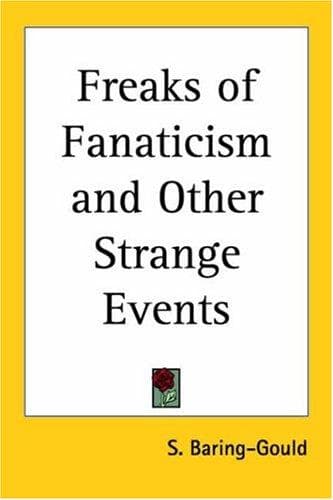
Freaks of Fanaticism, and Other Strange EventsBaring-Gould, S. (Sabine)
Religion
Freaks of Fanaticism, and Other Strange Events
Baring-Gould, S. (Sabine)
History; Mysticism; Patarines
her notice to leave the town. She then made a pilgrimage along the
Rhine, but her proceedings were everywhere objected to by the police
and town authorities, and she was sent back under police supervision
first to Leipzig, and thence into Russia.
Thence in 1824 she departed for the Crimea, where she had resolved
to start a colony on the plan of the Moravian settlements, and there
died before accomplishing her intention.
It was in 1817, when she was conducting her apostolic progress along
the Rhine, that she and Margaretta of Wildisbuch met. Apparently the
latter made a deeper impression on the excitable baroness than had
the holy Julianne on Margaretta. The two aruspices did not laugh
when they met, for they were both in deadly earnest, and had not
the smallest suspicion that they were deluding themselves first, and
then others.
The meeting with the Krüdner had a double effect. In the first
place, the holy Julianne, when forced to leave the neighbourhood
by the unregenerate police, commended her disciples to the blessed
Margaret; and, in the second place, the latter had the shrewdness
to perceive, that, if she was to play anything like the part of
her fellow-apostle, she must acquire a little more education.
Consequently Margaret took pains to write grammatically, and to
spell correctly.
The result of the commendation by Saint Julianne of her disciples
to Margaret was that thenceforth a regular pilgrimage set in to
Wildisbuch of devout persons in landaus and buggies, on horse and on
foot.
Some additional actors in the drama must now be introduced.
Magdalena Peter, the fourth daughter of John Peter, was married to
the cobbler, John Moser. The influence of Margaret speedily made
itself felt in their house. At first Moser's old mother lived with
the couple, along with Conrad, John Moser's younger brother. The
first token of the conversion of Moser and his wife was that they
kicked the old mother out of the house, because she was worldly and
void of "saving grace." Conrad was a plodding, hard-working lad,
very useful, and therefore not to be dispensed with. The chosen
vessels finding he did not sympathise with them, and finding him too
valuable to be done without, starved him till he yielded to their
fancies, saw visions, and professed himself "saved." Barbara, also,
married to the blacksmith Baumann, was next converted, and brought
all her spiritual artillery to bear on the blacksmith, but in vain.
He let her go her own way, but he would have nothing himself to say
to the great spiritual revival in the house of the Peters. Barbara,
not finding a kindred soul in her husband, had taken up with a man
of like soaring piety, a tailor, named Hablützel.
Another person who comes into this story is Jacob Ganz, a tailor,
who had been mixed up with the movement at Basel under Julianne the
Holy.
Public-domain text, read in full here on John Shaqi.
Reviews
Reviews
No reviews yet
Be the first to share your thoughts on this work.
Join the Discussion
Join the discussion
Sign in to leave a comment or review.
Sign InorCreate an account