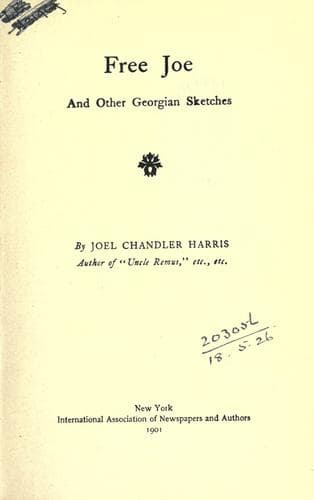
Free Joe and Other Georgian SketchesHarris, Joel Chandler
General
Free Joe and Other Georgian Sketches
Harris, Joel Chandler
Georgia -- Social life and customs -- Fiction
"Why, yes," said the landlord. "He's a Yankee; and that lady you seen
drivin' him around, she's a Yankee. He courted her here and he married
her here. Major Jimmy Bass wanted him to marry her in his house, but
Captain Jack Walthall put his foot down and said the weddin' had to be
in _his_ house; and there's where it was, in that big white house over
yander with the hip roof. Yes, sir."
"Oh," said the commercial traveler, with a cynical smile, "he stayed
down here to keep out of the army. He was a lucky fellow."
"Well, I reckon he was lucky not to get killed," said the landlord,
laughing. "He fought with the Yankees, and they do say that Little
Compton was a rattler."
The commercial traveler gave a long, low whistle, expressive of his
profound astonishment. And yet, under all the circumstances, there was
nothing to create astonishment. The lively little man had a history.
Among the genial and popular citizens of Hillsborough, in the days
before the war, none were more genial or more popular than Little
Compton. He was popular with all classes, with old and with young, with
whites and with blacks. He was sober, discreet, sympathetic, and
generous. He was neither handsome nor magnetic. He was awkward and
somewhat bashful, but his manners and his conversation had the rare
merit of spontaneity. His sallow face was unrelieved by either mustache
or whiskers, and his eyes were black and very small, but they glistened
with good-humor and sociability. He was somewhat small in stature, and
for that reason the young men about Hillsborough had given him the name
of Little Compton.
Little Compton's introduction to Hillsborough was not wholly without
suggestive incidents. He made his appearance there in 1850, and opened a
small grocery store. Thereupon the young men of the town, with nothing
better to do than to seek such amusement as they could find in so small
a community, promptly proceeded to make him the victim of their pranks
and practical jokes. Little Compton's forbearance was wonderful. He
laughed heartily when he found his modest signboard hanging over an
adjacent barroom, and smiled good-humoredly when he found the sidewalk
in front of his door barricaded with barrels and dry-goods boxes. An
impatient man would have looked on these things as in the nature of
indignities, but Little Compton was not an impatient man.
This went on at odd intervals, until at last the fun-loving young men
began to appreciate Little Compton's admirable temper; and then for a
season they played their jokes on other citizens, leaving Little Compton
entirely unmolested. These young men were boisterous, but good-natured,
and they had their own ideas of what constituted fair play. They were
ready to fight or to have fun, but in neither case would they willingly
take what they considered a mean advantage of a man.
Public-domain text, read in full here on John Shaqi.
Reviews
Reviews
No reviews yet
Be the first to share your thoughts on this work.
Join the Discussion
Join the discussion
Sign in to leave a comment or review.
Sign InorCreate an account