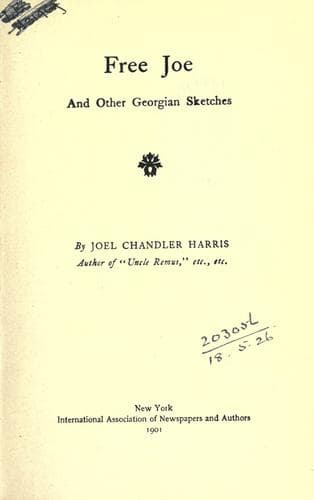
Free Joe and Other Georgian SketchesHarris, Joel Chandler
General
Free Joe and Other Georgian Sketches
Harris, Joel Chandler
Georgia -- Social life and customs -- Fiction
No one could ever explain why the handsome and gallant Jack Walthall
should go so far as to stand between his own cousin and Little Compton;
indeed, no one tried to explain it. The fact was accepted for what it
was worth, and it was a great deal to Little Compton in a social and
business way. After the row which has just been described, Mr. Walthall
was usually to be found at Compton's store--in the summer sitting in
front of the door under the grateful shade of the China trees, and in
the winter sitting by the comfortable fire that Compton kept burning in
his back room. As Mr. Walthall was the recognized leader of the young
men, Little Compton's store soon became the headquarters for all of
them. They met there, and they made themselves at home there,
introducing their affable host to many queer antics and capers peculiar
to the youth of that day and time, and to the social organism of which
that youth was the outcome.
That Little Compton enjoyed their company is certain; but it is doubtful
if he entered heartily into the plans of their escapades, which they
freely discussed around his hearth. Perhaps it was because he had
outlived the folly of youth. Though his face was smooth and round, and
his eye bright, Little Compton bore the marks of maturity and
experience. He used to laugh, and say that he was born in New Jersey,
and died there when he was young. What significance this statement
possessed no one ever knew; probably no one in Hillsborough cared to
know. The people of that town had their own notions and their own
opinions. They were not unduly inquisitive, save when their
inquisitiveness seemed to take a political shape; and then it was
somewhat aggressive.
There were a great many things in Hillsborough likely to puzzle a
stranger. Little Compton observed that the young men, no matter how
young they might be, were absorbed in politics. They had the political
history of the country at their tongues' ends, and the discussions they
carried on were interminable. This interest extended to all classes: the
planters discussed politics with their overseers; and lawyers,
merchants, tradesmen, and gentlemen of elegant leisure discussed
politics with each other. Schoolboys knew all about the Missouri
Compromise, the fugitive slave law, and States rights. Sometimes the
arguments used were more substantial than mere words, but this was only
when some old feud was back of the discussion. There was one question,
as Little Compton discovered, in regard to which there was no
discussion. That question was slavery. It loomed up everywhere and in
everything, and was the basis of all the arguments, and yet it was not
discussed: there was no room for discussion. There was but one idea, and
that was that slavery must be defended at all hazards, and against all
enemies. That was the temper of the time, and Little Compton was not
long in discovering that of all dangerous issues slavery was the most
dangerous.
Public-domain text, read in full here on John Shaqi.
Reviews
Reviews
No reviews yet
Be the first to share your thoughts on this work.
Join the Discussion
Join the discussion
Sign in to leave a comment or review.
Sign InorCreate an account