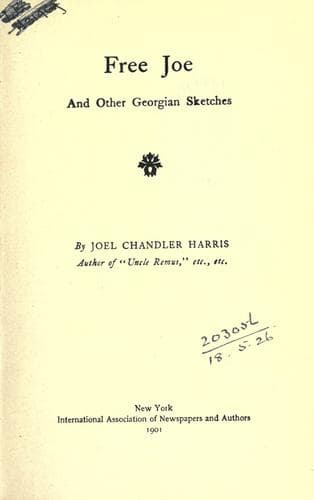
Free Joe and Other Georgian SketchesHarris, Joel Chandler
General
Free Joe and Other Georgian Sketches
Harris, Joel Chandler
Georgia -- Social life and customs -- Fiction
"I don't believe in no tar and feathers for this chap," remarked Major
Jimmy Bass, assuming a judicial air. "He'll just go out here to the town
branch and wash 'em off, and then he'll go on through the plantations
raising h---- among the niggers. That'll be the upshot of it--now, you
mark my words. He ought to be hung."
"Now, boys," said Little Compton, still protesting, "what is the use?
This man hasn't done any real harm. He might preach insurrection around
here for a thousand years, and the niggers wouldn't listen to him. Now,
you know that yourselves. Turn the poor devil loose, and let him get out
of town. Why, haven't you got any confidence in the niggers you've
raised yourselves?"
"My dear sir," said Rowan Wornum, in his most insinuating tone, "we've
got all the confidence in the world in the niggers, but we can't afford
to take any risks. Why, my dear sir," he went on, "if we let this chap
go, it won't be six months before the whole country'll be full of this
kind. Look at that Harper's Ferry business."
"Well," said Compton somewhat hotly, "look at it. What harm has been
done? Has there been any nigger insurrection?"
Jack Walthall laughed good-naturedly. "Little Compton is a quick talker,
boys. Let's give the man the benefit of all the arguments."
"Great God! You don't mean to let this d---- rascal go, do you, Jack?"
exclaimed Major Jimmy Bass.
"No, no, sweet uncle; but I've got a nicer dose than tar and feathers."
The result was that the stranger's face and hands were given a coat of
lampblack, his arms were tied to his body, and a large placard was
fastened to his back. The placard bore this inscription:
ABOLITIONIST!
PASS HIM ON, BOYS
Mr. Davies was a pitiful-looking object after the young men had
plastered his face and hands with lampblack and oil, and yet his
appearance bore a certain queer relation to the humorous exhibitions one
sees on the negro minstrel stage. Particularly was this the case when he
smiled at Compton.
"By George, boys!" exclaimed Mr. Buck Ransome, "this chap could play Old
Bob Ridley at the circus."
When everything was arranged to suit them, the young men formed a
procession, and marched the blackened stranger from Little Compton's
door into the public street. Little Compton seemed to be very much
interested in the proceeding. It was remarked afterward that he seemed
to be very much agitated, and that he took a position very near the
placarded abolitionist. The procession, as it moved up the street,
attracted considerable attention. Rumors that an abolitionist was to be
dealt with had apparently been circulated, and a majority of the male
inhabitants of the town were out to view the spectacle. The procession
passed entirely around the public square, of which the court-house was
the centre, and then across the square to the park-like enclosure that
surrounded the temple of justice.
Public-domain text, read in full here on John Shaqi.
Reviews
Reviews
No reviews yet
Be the first to share your thoughts on this work.
Join the Discussion
Join the discussion
Sign in to leave a comment or review.
Sign InorCreate an account