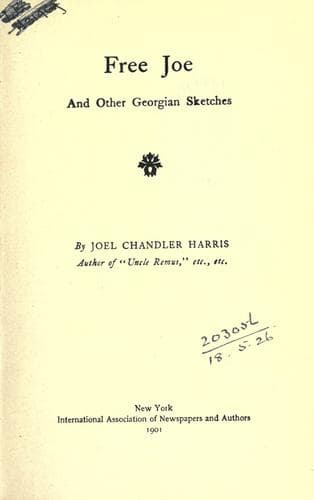
Free Joe and Other Georgian SketchesHarris, Joel Chandler
General
Free Joe and Other Georgian Sketches
Harris, Joel Chandler
Georgia -- Social life and customs -- Fiction
It happened that one day in July, Captain Jack Walthall and his men,
together with quite an imposing array of comrades, were called upon to
breast the sultry thunder of Gettysburg. They bore themselves like men;
they went forward with a shout and a rush, facing the deadly slaughter
of the guns; they ran up the hill and to the rock wall. With others,
Captain Walthall leaped over the wall. They were met by a murderous
fire that mowed down the men like grass. The line in the rear wavered,
fell back, and went forward again. Captain Walthall heard his name
called in his front, and then some one cried, "Don't shoot!" and Little
Compton, his face blackened with powder, and his eyes glistening with
excitement, rushed into Walthall's arms. The order not to shoot--if it
was an order--came too late. There was another volley. As the
Confederates rushed forward, the Federal line retreated a little way,
and Walthall found himself surrounded by the small remnant of his men.
The Confederates made one more effort to advance, but it was useless.
The line was borne back, and finally retreated; but when it went down
the slope, Walthall and Lieutenant Ransome had Little Compton between
them. He was a prisoner. Just how it all happened, no one of the three
could describe, but Little Compton was carried into the Confederate
lines. He was wounded in the shoulder and in the arm, and the ball that
shattered his arm shattered Walthall's arm.
They were carried to the field hospital, where Walthall insisted that
Little Compton's wounds should be looked after first. The result was
that Walthall lost his left arm and Compton his right; and then, when by
some special interposition of Providence they escaped gangrene and other
results of imperfect surgery and bad nursing, they went to Richmond,
where Walthall's money and influence secured them comfortable quarters.
Hillsborough had heard of all this in a vague way--indeed, a rumor of it
had been printed in the Rockville "Vade Mecum"--but the generals and
commanders in consultation at Perdue's Corner were astonished one day
when the stage-coach set down at the door of the tavern a tall,
one-armed gentleman in gray, and a short, one-armed gentleman in blue.
"By the livin' Lord!" exclaimed Major Jimmy Bass, "if that ain't Jack
Walthall! And you may put out my two eyes if that ain't Little Compton!
Why, shucks, boys!" he exclaimed, as he waddled across the street, "I'd
'a' know'd you anywheres. I'm a little short-sighted, and I'm mighty
nigh took off wi' the dropsy, but I'd 'a' know'd you anywheres."
Public-domain text, read in full here on John Shaqi.
Reviews
Reviews
No reviews yet
Be the first to share your thoughts on this work.
Join the Discussion
Join the discussion
Sign in to leave a comment or review.
Sign InorCreate an account