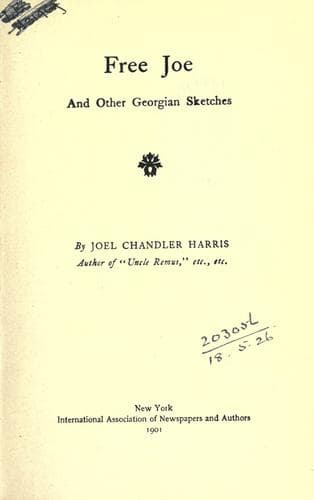
Free Joe and Other Georgian SketchesHarris, Joel Chandler
General
Free Joe and Other Georgian Sketches
Harris, Joel Chandler
Georgia -- Social life and customs -- Fiction
After this incident Free Joe appeared to have clearer ideas concerning
his peculiar condition. He realized the fact that though he was free he
was more helpless than any slave. Having no owner, every man was his
master. He knew that he was the object of suspicion, and therefore all
his slender resources (ah! how pitifully slender they were!) were
devoted to winning, not kindness and appreciation, but toleration; all
his efforts were in the direction of mitigating the circumstances that
tended to make his condition so much worse than that of the negroes
around him--negroes who had friends because they had masters.
So far as his own race was concerned, Free Joe was an exile. If the
slaves secretly envied him his freedom (which is to be doubted,
considering his miserable condition), they openly despised him, and lost
no opportunity to treat him with contumely. Perhaps this was in some
measure the result of the attitude which Free Joe chose to maintain
toward them. No doubt his instinct taught him that to hold himself aloof
from the slaves would be to invite from the whites the toleration which
he coveted, and without which even his miserable condition would be
rendered more miserable still.
His greatest trouble was the fact that he was not allowed to visit his
wife; but he soon found a way out of his difficulty. After he had been
ordered away from the Calderwood place, he was in the habit of wandering
as far in that direction as prudence would permit. Near the Calderwood
place, but not on Calderwood's land, lived an old man named Micajah
Staley and his sister Becky Staley. These people were old and very
poor. Old Micajah had a palsied arm and hand; but, in spite of this, he
managed to earn a precarious living with his turning-lathe.
When he was a slave Free Joe would have scorned these representatives of
a class known as poor white trash, but now he found them sympathetic and
helpful in various ways. From the back door of their cabin he could hear
the Calderwood negroes singing at night, and he sometimes fancied he
could distinguish Lucinda's shrill treble rising above the other voices.
A large poplar grew in the woods some distance from the Staley cabin,
and at the foot of this tree Free Joe would sit for hours with his face
turned toward Calderwood's. His little dog Dan would curl up in the
leaves near by, and the two seemed to be as comfortable as possible.
One Saturday afternoon Free Joe, sitting at the foot of this friendly
poplar, fell asleep. How long he slept, he could not tell; but when he
awoke little Dan was licking his face, the moon was shining brightly,
and Lucinda his wife stood before him laughing. The dog, seeing that
Free Joe was asleep, had grown somewhat impatient, and he concluded to
make an excursion to the Calderwood place on his own account. Lucinda
was inclined to give the incident a twist in the direction of
superstition.
Public-domain text, read in full here on John Shaqi.
Reviews
Reviews
No reviews yet
Be the first to share your thoughts on this work.
Join the Discussion
Join the discussion
Sign in to leave a comment or review.
Sign InorCreate an account