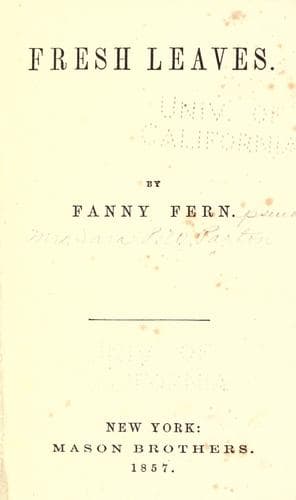
American essays -- 19th century; Short stories, American
“I think it must be time for Henry to come home,” and the speaker
glanced at a little gold watch on the mantel. “What a noise those
children are making. I told them to keep still, but after all, I’m glad
that they didn’t mind me; the most pitiful sight on earth to me, is a
child with a feeble body and a large head, who never plays. Let them
romp--broken chairs are easier mended than broken spines; who would be a
slave to an upholstery shop, or a set of porcelain; who would keep awake
at night to watch the key which locks up a set of gold or silver? Who
would mew children up in the nursery for fear of a parlor carpet? My
parlor is not too good for my children to play in, and I hope it never
will be. Now I will go down and take out some cake for tea; how glad I
am Henry loves cake, because I know so well how to make it; who would
have thought I should have had such a good husband, and such a happy
home--poor mamma--and she deserves it so much better than I. Sometimes I
think I ought never to have left home while she lived, but have staid to
comfort her. Oh my children must be very--very happy; childhood comes
but once--but once.”
So said Mary Hereford, Mr. Wade’s married daughter, as she picked up
the toys, and picture-books, and strings, and marbles, with which her
romping children had strewed her chamber floor.
Mary Hereford was no beauty. She had neither golden brown, nor raven
hair; her skin was not transparently white, nor her eyes dazzlingly
bright, nor her foot and hand miraculously small. She was simply a
plump, healthy, rosy, cheerful little cricket of a woman--singing ever
at her own hearth-stone--proud of her husband--proud of her children,
knowing no weariness in their service. Many a beautiful woman has wrung
her white hands in vain for the love which lent wings to this
unhandsome, but still lovely little wife, dignified even the most
common-place employment, and made her heart a temple for sweet and holy
thoughts to gather.
“Yes, there comes Henry now,” said Mary, and before the words were
well out of her mouth, her husband held her at arm’s length, and looked
into her face.
“You have been sewing too steadily, little wife,” said he; “I must
take you out for a walk after tea. I shall get a sempstress to help you
if these children out-grow their clothes so fast.”
Public-domain text, read in full here on John Shaqi.
Reviews
Reviews
No reviews yet
Be the first to share your thoughts on this work.
Join the Discussion
Join the discussion
Sign in to leave a comment or review.
Sign InorCreate an account