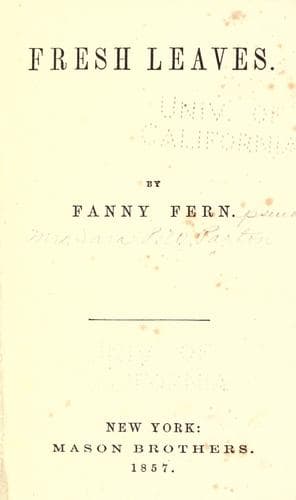
American essays -- 19th century; Short stories, American
One day, after my arrival in New York, I met a man striding down
street, in the face of a pin-and-needle wind, that was blowing his long
hair away from his bloodshot eyes, and forcing him to compress his lips,
to keep what breath he had--inside--to warm him; tall and lank, he
clutched his rough blanket shawl about him like a brigand. Fearing he
might be an escaped lunatic, I gave him a wide berth on the sidewalk.
Each day, in my walks, I met him, till at last I learned to watch for
the wearied, haggard-looking face; I think the demonism of it magnetized
me. After looking at the kidded dandies, who flourished their perfumed
handkerchiefs past, the sight of him was as refreshing as a grand, black
thunder cloud, looming up in the horizon, after the oppressive
hum-drum-ness of a sultry day. One night I was at the opera; and amid
its blaze, and glitter, and glare, was that haggard face, looking
tenfold more satanic than ever. Grisi charmed him not, nor Mario either.
Ah--that strain! who could resist it? A luminous smile in an instant
transforms Lucifer--was that the same haggard face, upon which, but one
moment ago, every passing hour had seemed to set its seal of care, and
sorrow, and disappointment?
What was that smile like?
It was like the glorious outbursting of the sun on bud and tree, and
blossom, when the thunder cloud has rolled away. It was like the sudden
flashing of light through a crystal vase, revealing the delicate tracery
of _His_ fingers who made man _originally_ “but little lower than the
angels.”
And so when I hear Mr. Fry, the musical thunderer of the “Tribune,”
called “gaunt” and “ugly”--I shake my head incredulously; and when I
read in the “Tribune” a biting article from his caustic pen, dissecting
poor Napoleon (who certainly expiated all his sins, even that wretched
divorce, when he fretted his eagle soul away at St. Helena, beating his
strong, but powerless wings, heavily against his English prison bars);
when I read Mr. Fry’s vulture-like dissection of Napoleon, I recall that
luminous music-born smile, and rejoice that in every man’s heart is an
oasis which the Simoon-breath of worldly care, and worldly toil and
ambition has no power to blight!
And here comes Barnum--poor Barnum! late so _riant_ and rosy. Kick not
the prostrate lion, ye crowing changelings; you may yet feel his paws in
your faces; Mammon grant it! not for the love I bear to “woolly horses,”
but for the hate I bear to pharisaical summer friends.
Ah! here comes Count Gurowski; Mars of the “Tribune.” Oh! the
knowledge buttoned up in that shaggy black overcoat! Oh! the prophet
eyes hid by those ugly green goggles! Not a move on the European
checker-board escapes their notice; but no film of patriotism can cloud
to their Russian owner the fall of Sebastopol; and while we gladly
welcome rare foreign talent like his to our shores, our cry still must
be, “Down with tyranny and tyrants.”
Public-domain text, read in full here on John Shaqi.
Reviews
Reviews
No reviews yet
Be the first to share your thoughts on this work.
Elsewhere in the archive
Join the Discussion
Join the discussion
Sign in to leave a comment or review.
Sign InorCreate an account