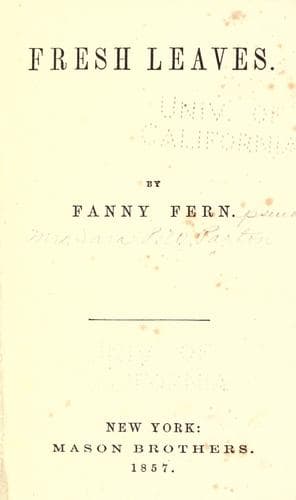
American essays -- 19th century; Short stories, American
And there is Briggs; whilome editor of “Putnam’s Monthly,” now
factotum of the “New York Times,” a most able writer and indefatigable
worker. People judge him to be unamiable because his pen has a sharp
nib. Fudge! one knows what to expect from a torpedo, but who can count
on an eel? I trust no malicious person will twist this question to the
disparagement of Briggs’s editorial coadjutor.
And here, by the rood, comes FANNY FERN! FANNY is a woman. For that
she is not to blame; though since she first found it out, she has never
ceased to deplore it. She might be prettier; she might be younger. She
might be older; she might be uglier. She might be better; she might be
worse. She has been both over-praised and over-abused, and those who
have abused her worst, have imitated and copied her most.
One thing may be said in favor of FANNY: she was NOT, thank
Providence, born in the beautiful, backbiting, sanctimonious,
slandering, clean, contumelious, pharisaical, phiddle-de-dee,
peck-measure city--of Boston!
Look!
Which? How? Where?
Why _there_; don’t you see? there’s Potiphar Curtis.
Potiphar Curtis! Ye gods, what a name! Pity my ignorance, reader, I
had not then heard of the great “Howadji”--the only Potiphar I knew of
being that much-abused ancient who--but never mind him; suffice it to
say, I had not heard of “Howadji;” and while I stood transfixed with his
ridiculous cognomen, his coat tails, like his namesake’s rival’s, were
disappearing in the distance. So I can not describe him for you; but I
give you my word, should I ever see him, to do him justice to the tips
of his boots, which, I understand, are of immaculate polish. I have read
his “Papers” though, and to speak in the style of the patronizing
critics who review lady-books, they are very well--_for a man_.
* * * * *
I was sauntering along one sunny day last week, when I saw before me a
young girl, hooped, flounced, fringed, laced, bugled, and ribboned,
regardless of cost. Her mantilla, whether of the “Eugenie” or “Victoria”
pattern I am too ignorant to inform you, was of black, and had more
trimming than I could have believed the most ingenious of dressmakers
could pile on _one_ mantilla, though backed by every dry goods merchant
in New York. Venus! what a figure it was hung on! Short, flat-chested,
narrow-shouldered, angular, and stick-like! her bonnet was a marvel of
Lilliputianism, lightness, and lilacs. Raphael! what a face was under
it! Watery, yellow, black eyes, a sallow, unwholesome skin,
and--Bardolph! what a nose! Imagine a spotted “Seckle pear”--imagine a
gnarled bulb-root--imagine a vanquished prize-fighter’s proboscis, and
you have it! That such a female, with such repulsive features, living in
a Christian country, where there were looking-glasses, should strain
back from the roots what little hair she had, as if her face were
beautiful in its outline--it was incredible.
Public-domain text, read in full here on John Shaqi.
Reviews
Reviews
No reviews yet
Be the first to share your thoughts on this work.
Elsewhere in the archive
Join the Discussion
Join the discussion
Sign in to leave a comment or review.
Sign InorCreate an account