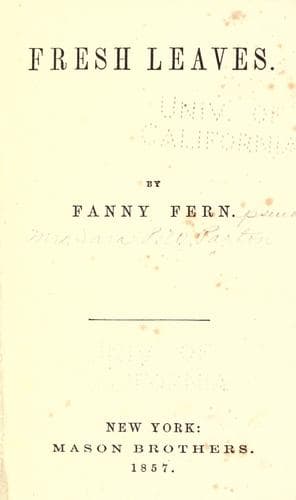
American essays -- 19th century; Short stories, American
When the young bride first realized the import of those words she had
been made to utter, “till death do us part,” she looked forward, with
shuddering horror, at the long, monotonous, weary years before her. Her
home seemed a prison, and Mark Ware the keeper; its very splendor
oppressed her; and she chafed and fretted in her gilded fetters, while
her restless heart cried out--anywhere but home! Must she sit there, in
her prison-house, day after day, listening only to the repinings of her
own troubled heart? Must the bee and the butterfly only be free to revel
in the bright sunshine? Had God made her beauty to fade in the stifling
atmosphere of darkened parlors, listening to the complaints of querulous
old age? Every pulse of her heart rebelled. How could her mother have
thus sold her? How could Mark Ware have so unmagnanimously accepted the
compulsory sacrifice? Why not have shown her the world and let her
choose for herself? O anywhere--anywhere--from such a home!
There was no lack of invitations abroad; for Mary had flashed across
the fashionable horizon, like some bright comet; eclipsing all the
reigning beauties. No ball, no party, no dinner, was thought a success
without her. Night after night found her _en route_ to some gay
assemblage. To her own astonishment and her foolish mother’s delight,
her husband never remonstrated; on the contrary, she often found upon
her dressing-table, some choice little ornament, which he had provided
for the occasion; and Mary, as she fastened it in her hair, or bosom,
would say, bitterly, “He is anxious that I, like the other appendages of
his establishment, should reflect credit on his faultless taste.”
Mistaken Mary!
Time passed on. Mark Ware _was_ “patient,” as he promised himself to
be. His evenings were not so lonely now, for his little babe kept him
company; the reprieved nurse, only too glad to escape to her pink
ribbons and a “chat with John at the back gate.” It was a pretty
sight--Mark and the babe! Old age and infancy are always a touching
sight together. Not a smile or a cloud passed over that little face,
that did not wake up all the father in Mark Ware’s heart; and he paced
the room with it, or rocked it to sleep on his breast, talking to it, as
if it could understand the strong, deep love, of which it was the
unconscious object.
* * * * *
“I am weary of all this,” said Mark’s young wife, as she stepped into
her carriage, at the close of a brilliant ball. “I am weary of seeing
the same faces, and hearing the same stupid nonsense, night after night.
I wonder shall I _ever_ be happy? I wonder shall I ever _love_ any
thing, or anybody? Mamma is proud of me, because I am beautiful and
rich, but she does not _love_ me. Mark is proud of me”--and Mary’s
pretty lip curled scornfully. “Life is so weary, and I am only
eighteen!” and Mary sighed heavily.
Public-domain text, read in full here on John Shaqi.
Reviews
Reviews
No reviews yet
Be the first to share your thoughts on this work.
Join the Discussion
Join the discussion
Sign in to leave a comment or review.
Sign InorCreate an account