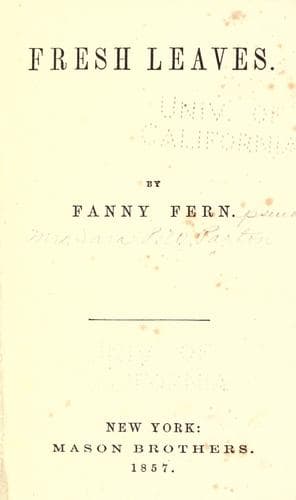
American essays -- 19th century; Short stories, American
“I like peddlers,” said little Fanny, as she watched her new friend
saunter slowly down the road. “He gave me this pretty wreath and this
ribbon; I am sorry he didn’t like mamma’s picture; he hardly looked at
it at all.”
“The peddler never heard of your mamma, my darling; you must not
expect strangers to feel as you and grandma do about it.”
“Yes,” replied Fanny, in a disappointed tone;--“but it is a pity,
because I like him. There he goes; now he has climbed the fence, and is
crossing the meadow. Good by, Mr. Peddler.”
Yes--across the meadow, down the little grassy lane, over the
stile--far into the dim--dim woods, where no human eye could penetrate,
prostrate upon the earth, shedding such tears as manhood seldom sheds,
lay the peddler. Still in his ears lingered that bird-like voice, still
in his veins thrilled the touch of that tiny hand, and those silken
curls, in whose every glossy wave shone out Mary’s self. Mary--yet not
Mary; Mary’s child--yet not _his_ child!--And Lucy, too;--O, the sorrow
written in every furrow of that kindly face, and--O God--by whom?
The stars glimmered through the trees, the night-winds gently rocked
the little merry birds to sleep--midnight came on with its solemn
spirit-whispers--followed the gray dawn with its misty tears, and
still--there lay the peddler, stricken, smitten, on Nature’s kindly
breast; for there, too (but all unconscious of his misery--deaf to his
penitence), lay pillowed the dear head which had erst drooped so
lovingly upon his breast.
CHAPTER XV.
“Very well done; button-holes strong and even, lining smooth;
stitching, like rows of seed pearl. This is no apprentice work,” said
Mr. John Pray, as he held Lucy’s vests up to the light for a more minute
inspection. “That’s a vest, now, as is a vest; won’t disgrace John
Pray’s shop; it would gladden even the eyes of my old boss, Jacob Ford;
and mighty particular he was, too, and mighty small wages the old man
paid, as I have occasion to know. Well, I made a vow then, and thank God
I have had grace to keep it, that if ever John Pray became a master
workman, he would do as he would be done by. So, I don’t ask what wages
other tailors give; that don’t matter to me. I don’t want to die with
any body’s groans in my ears. So, when a piece of work is finished and
handed in, I say, ‘Now, John Pray, what should _you_ think was a fair
price for _you_ to receive, if _you_ had done that ’ere job?’ That’s it;
no dodging behind that question. ’Specially when a man has been through
the opera_tive_ mill himself. So, there’s your pay, Zekiel, weighed out
in that ere pair of Bible scales; and you may tell the old lady, as you
call her, that if she had served a regular apprenticeship at the trade,
she couldn’t have done better. What did you say her name was? However,
that’s no consequence--as long as she does the work well. Here’s some
more vests for her.”
Public-domain text, read in full here on John Shaqi.
Reviews
Reviews
No reviews yet
Be the first to share your thoughts on this work.
Elsewhere in the archive
Join the Discussion
Join the discussion
Sign in to leave a comment or review.
Sign InorCreate an account