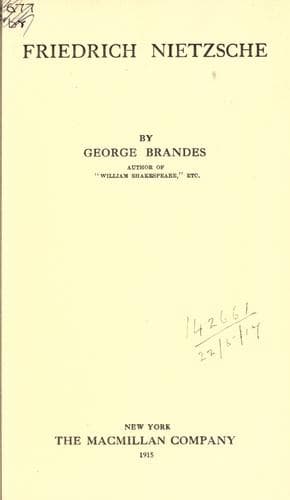
Nietzsche, Friedrich Wilhelm, 1844-1900; Philosophers -- Germany -- Biography; Philosophy, German -- 19th century
Even philosophy, Nietzsche complains, with a side-glance at the German
universities, has been more and more transformed into the history of
philosophy, a teaching of what everybody has thought about everything;
"a sort of harmless gossip between academic grey-beards and academic
sucklings." It is boasted as a point of honour that freedom of thought
exists in various countries. In reality it is only a poor sort of
freedom. One may think in a hundred ways, but one may only act in one
way--and that is the way that is called "culture" and is in reality
"only a form, and what is more a bad form, a uniform."
Nietzsche attacks the view which regards the historically cultured
person as the justest of all. We honour the historian who aims at pure
knowledge, from which nothing follows. But there are many trivial
truths, and it is a misfortune that whole battalions of inquirers
should fling themselves upon them, even if these narrow minds belong to
honest men. The historian is looked upon as objective when he measures
the past by the popular opinions of his own time, as subjective when
he does not take these opinions for models. That man is thought best
fitted to depict a period of the past, who is not in the least affected
by that period. But only he who has a share in building up the future
can grasp what the past has been, and only when transformed into a work
of art can history arouse or even sustain instincts.
As historical education is now conducted, the mass of impressions
communicated is so great as to produce numbness, a feeling of being
born old of an old stock--although less than thirty human lives,
reckoned at seventy years each, divide us from the beginning of our
era. And with this is connected the immense superstition of the
value and significance of universal history. Schiller's phrase is
everlastingly repeated: "The history of the world is the tribunal of
the world," as though there could be any other historical tribunal
than thought; and the Hegelian view of history as the ever-clearer
self-revelation of the godhead has obstinately held its own, only that
it has gradually passed into sheer admiration of success, an approval
of any and every fact, be it never so brutal. But greatness has nothing
to do with results or with success. Demosthenes, who spoke in vain, is
greater than Philip, who was always victorious. Everything in our day
is thought to be in order, if only it be an accomplished fact; even
when a man of genius dies in the fulness of his powers, proofs are
forthcoming that he died at the right time. And the fragment of history
we possess is entitled "the world process"; men cudgel their brains,
like Eduard von Hartmann, in trying to find out its origin and final
goal--which seems to be a waste of time. Why you exist, says Nietzsche
with Sören Kierkegaard, nobody in the world can tell you in advance;
but since you do exist, try to give your existence a meaning by setting
up for yourself as lofty and noble a goal as you can.
Public-domain text, read in full here on John Shaqi.
Reviews
Reviews
No reviews yet
Be the first to share your thoughts on this work.
Join the Discussion
Join the discussion
Sign in to leave a comment or review.
Sign InorCreate an account