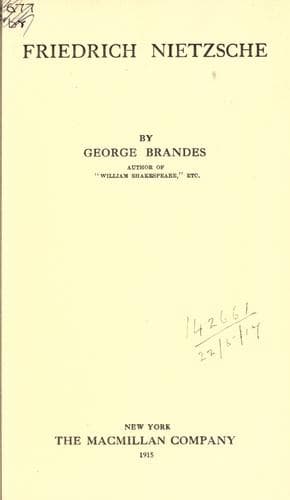
Nietzsche, Friedrich Wilhelm, 1844-1900; Philosophers -- Germany -- Biography; Philosophy, German -- 19th century
Nietzsche does not occupy himself for an instant with the state of
things in which revenge does duty as the sole punitive justice; for
the death feud is not a manifestation of the thrall's hatred of his
master, but of ideas of honour among equals. He dwells exclusively on
the contrast between a ruling caste and a caste of slaves, and shows
a constantly recurring indignation with doctrines which have caused
the progressive among his contemporaries to look with indulgence on
the instincts of the populace and with suspicion or hostility on
master spirits. His purely personal characteristic, however, the
unphilosophical and temperamental in him, is revealed in the trait
that, while he has nothing but scorn and contempt for the down-trodden
class or race, for the _slave morality_ resulting from its suppressed
rancour, he positively revels in the ruling caste's delight in its
power, in the atmosphere of healthiness, freedom, frankness and
truthfulness in which it lives. Its acts of tyranny he defends or
excuses. The image it creates for itself of the slave caste is to him
far less falsified than that which the latter forms of the master caste.
Nor can there be serious question of any real injustice committed by
this caste. For there is no such thing as right or wrong in itself.
The infliction of an injury, forcible subjection, exploitation or
annihilation is not in itself a wrong, cannot be such, since life in
its essence, in its primary functions, is nothing but oppression,
exploitation and annihilation. Conditions of justice can never be
anything but exceptional conditions, that is, as limitations of the
real desire of life, the object of which is power.
Nietzsche replaces Schopenhauer's _Will to Life_ and Darwin's _Struggle
for Existence_ by the _Will to Power_. In his view the fight is not
for life--bare existence--but for power. And he has a great deal to
say--somewhat beside the mark--of the mean and paltry conditions those
Englishmen must have had in view who set up the modest conception of
the struggle for life. It appears to him as if they had imagined a
world in which everybody is glad if he can only keep body and soul
together. But life is only an expression for the minimum. In itself
life seeks, not self-preservation alone, but self-increase, and this
is precisely the "will to power." It is therefore obvious that there
is no difference of principle between the new catchword and the old;
for the struggle for existence necessarily leads to the conflict of
forces and the fight for power. Now a system of justice, seen from
this standpoint, is a factor in the conflict of forces. Conceived
as supreme, as a remedy for every kind of struggle, it would be a
principle hostile to life and destructive of the future and progress of
humanity.
Public-domain text, read in full here on John Shaqi.
Reviews
Reviews
No reviews yet
Be the first to share your thoughts on this work.
Join the Discussion
Join the discussion
Sign in to leave a comment or review.
Sign InorCreate an account