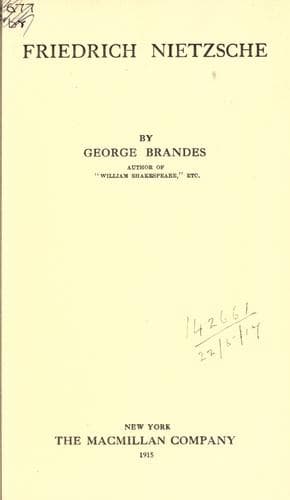
Nietzsche, Friedrich Wilhelm, 1844-1900; Philosophers -- Germany -- Biography; Philosophy, German -- 19th century
It is strange that this man, who learned such an immense amount from
French moralists and psychologists like La Rochefoucauld, Chamfort
and Stendhal, was able to acquire so little of the self-control of
their form. He was never subjected to the restraint which the literary
tone of France imposes upon every writer as regards the mention and
exhibition of his own person. For a long time he seems to have striven
to discover himself and to become completely himself. In order to find
himself he crept into his solitude, as Zarathustra into his cave. By
the time he had succeeded in arriving at full independent development
and felt the rich flow of individual thought within him, he had lost
all external standards for measuring his own value; all bridges to the
world around him were broken down. The fact that no recognition came
from without only aggravated his self-esteem. The first glimmer of
recognition further exalted this self-esteem. At last it closed above
his head and darkened this rare and commanding intellect.
As he stands disclosed in his incompleted life-work, he is a writer
well worth studying.
My principal reason for calling attention to him is that Scandinavian
literature appears to me to have been living quite long enough on the
ideas that were put forward and discussed in the last decade. It looks
as though the power of conceiving great ideas were on the wane, and
even as though receptivity for them were fast vanishing; people are
still busy with the same doctrines, certain theories of heredity, a
little Darwinism, a little emancipation of woman, a little morality of
happiness, a little freethought, a little worship of democracy, etc.
And as to the culture of our "cultured" people, the level represented
approximately by the Revue des Deux Mondes threatens to become the
high-water mark of taste. It does not seem yet to have dawned on the
best among us that the finer, the only true culture begins on the far
side of the _Revue des Deux Mondes_ in the great personality, rich in
ideas.
The intellectual development of Scandinavia has advanced comparatively
rapidly in its literature. We have seen great authors rise above
all orthodoxy, though they began by being perfectly simple-hearted
believers. This is very honourable, but in the case of those who cannot
rise higher still, it is nevertheless rather meagre. In the course of
the 'seventies it became clear to almost all Scandinavian authors that
it would no longer do to go on writing on the basis of the Augsburg
Confession. Some quietly dropped it, others opposed it more or less
noisily; while most of those who abandoned it entrenched themselves
against the public, and to some extent against the bad conscience of
their own childhood, behind the established Protestant morality; now
and then, indeed, behind a good, everyday soup-stock morality--I call
it thus because so many a soup has been served from it.
Public-domain text, read in full here on John Shaqi.
Reviews
Reviews
No reviews yet
Be the first to share your thoughts on this work.
Join the Discussion
Join the discussion
Sign in to leave a comment or review.
Sign InorCreate an account