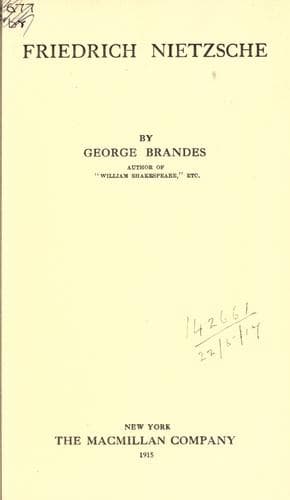
Nietzsche, Friedrich Wilhelm, 1844-1900; Philosophers -- Germany -- Biography; Philosophy, German -- 19th century
In his deepest instincts Nietzsche is now, as he asserts, so foreign
to everything German, that the mere presence of a German "retards his
digestion." German intellect is to him indigestion; it can never be
finished with anything. If he has been so enthusiastic in his devotion
to Wagner, if he still regards his intimate relationship with Wagner as
the most profound refreshment of his life, this was because in Wagner
he honoured the foreigner, because in him he saw the incarnate protest
against all German virtues. In his book, _The Case of Wagner_, he had
already hinted that Richard Wagner, the glory of German nationalism,
was of Jewish descent, since his real father seems to have been the
step-father, Geyer. I could not have survived my youth without Wagner,
he says; I was condemned to the society of Germans and had to take a
counter-poison; Wagner was the counter-poison.
Here, by way of exception, he generalises his feeling. We who were
children in the 'fifties, he says, necessarily became pessimists
in regard to the concept "German." We cannot be anything else than
revolutionaries. And he explains this expression thus: We can assent to
no state of affairs which allows the canting bigot to be at the top.
(Höffding's protest against the use of the word "radicalism" applied to
Nietzsche, in _Moderne Filosofer_, is thus beside the mark.) Wagner was
a revolutionary; he fled from the Germans. And, Nietzsche adds, as an
artist, a man has no other home than Paris--the city which, strangely
enough, he was never, to see. He ranks Wagner among the later masters
of French romanticism--Delacroix, Berlioz, Baudelaire--and wisely says
nothing about the reception of Wagnerian opera in Paris under the
Empire.
In everything Nietzsche now adopts the French stand-point--the old and
narrow French standpoint--that, for instance, of the elderly Voltaire
towards Shakespeare. He declares here, as he has done before, that
his artist's taste defends Molière, Corneille and Racine, not without
bitterness (_nicht ohne Ingrimm_) against such a wild (_wüstes_) genius
as Shakespeare. Strangely enough he repeats here his estimate of
Shakespeare's Cæsar as his finest creation, weak as it is: "My highest
formula for Shakespeare is that he conceived the type of Cæsar." It
must be added that here again Nietzsche assents to the unhappy delusion
that Shakespeare never wrote the works that bear his name. Nietzsche
is "instinctively" certain that they are due to Bacon, and, ignoring
repeated demonstrations of the impossibility of this fatuous notion, he
supports his conjecture by the grotesque assertion that if he himself
had christened his Zarathustra by a name not his own--by Wagner's, for
instance--the acumen of two thousand years would not have sufficed to
guess who was its originator; no one would have believed it possible
that the author of _Human, all-too-Human_ had conceived the visions of
Zarathustra.
Public-domain text, read in full here on John Shaqi.
Reviews
Reviews
No reviews yet
Be the first to share your thoughts on this work.
Elsewhere in the archive
Join the Discussion
Join the discussion
Sign in to leave a comment or review.
Sign InorCreate an account