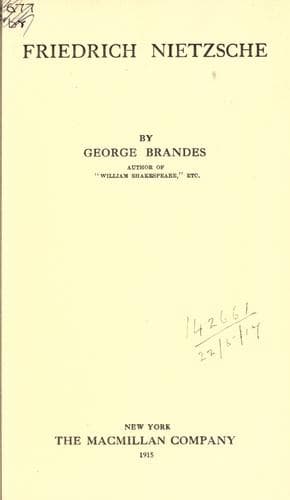
Nietzsche, Friedrich Wilhelm, 1844-1900; Philosophers -- Germany -- Biography; Philosophy, German -- 19th century
He allows the Germans no honour as philosophers: Leibniz and Kant were
"the two greatest clogs upon the intellectual integrity of Europe."
Just when a perfectly scientific attitude of mind had been attained,
they managed to find byways back to "the old ideal." And no less
passionately does he deny to the Germans all honour as musicians:
"A German _cannot_ know what music is. The men who pass as German
musicians are foreigners, Slavs, Croats, Italians, Dutchmen or Jews. I
am Pole enough to give up all other music for Chopin--except Wagner's
_Siegfried-Idyll_, some things of Liszt, and the Italians Rossini and
Pietro Gasti" (by this last name he appears to mean his favourite
disciple, Köselitz, who wrote under the pseudonym of Peter Gast).
He abhors the Germans as "idealists." All idealism is falsehood in
the face of necessity. He finds a pernicious idealism in Henrik Ibsen
too, "that typical old maid," as well, as in others whose object it
is to poison the clean conscience, the natural spirit, of sexual
love. And he gives us a clause of his moral code, in which, under the
head of Vice, he combats every kind of opposition to Nature, or if
fine words are preferred, every kind of idealism. The clause runs:
"Preaching of chastity is a public incitement to unnatural practices.
All, depreciation of the sexual life, all sullying of it with the word
'impure,' is a crime against Life itself--is the real sin against the
holy Spirit of Life."
Finally he attacks what he calls the "licentiousness" of the Germans
in historical matters. German historians, he declares, have lost all
eye for the values of culture; in fact, they have put this power of
vision under the ban of the Empire. They claim that a man must in the
first place be a German, must belong to the race. If he does, he is
in a position to determine values or their absence: the Germans are
thus the "moral order of the universe" in history; compared with the
power of the Roman Empire they are the champions of liberty; compared
with the eighteenth century they are the restorers of morality and of
the Categorical Imperative. "History is actually written on Imperial
German and Antisemitic lines--and Herr von Treitschke is not ashamed of
himself."
The Germans have on their conscience every crime against culture
committed in the last four centuries. As Nietzsche in his later years
was never tired of asserting, they deprived the Renaissance of its
meaning, they wrecked it by the Reformation; that is, by Luther, an
impossible monk who, owing to his impossibility, attacked the Church
and in so doing restored it. The Catholics would have every reason to
honour Luther's name.
Public-domain text, read in full here on John Shaqi.
Reviews
Reviews
No reviews yet
Be the first to share your thoughts on this work.
Elsewhere in the archive
Join the Discussion
Join the discussion
Sign in to leave a comment or review.
Sign InorCreate an account