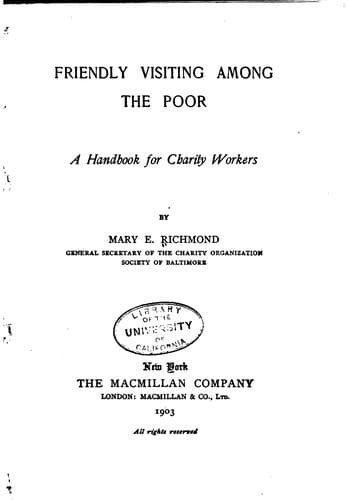
Friendly Visiting among the Poor: A Handbook for Charity Workers — John Shaqi
Friendly Visiting among the Poor: A Handbook for Charity WorkersRichmond, Mary Ellen
General
Friendly Visiting among the Poor: A Handbook for Charity Workers
Richmond, Mary Ellen
Friendly visiting
It is about such complicated relations as these that we must inform
ourselves when we dare to interfere, and charitable societies cannot
afford to adopt any patent formula with regard to them; they must be
courageous enough and intelligent enough to bear their part in the
solution of industrial questions. The individual friendly visitor may
be called upon at any time to advise an unemployed {32} workman whose
only immediate chance of work is in replacing a striker. His family
may be destitute, and their troubles may press heavily upon the
visitor, who sees in the offered work an easy solution of their
difficulties. But the visitor's duty toward the family does not end
with their material needs, and, unless the man who replaces the striker
is sure that the strike deserves to fail, he will have done an unmanly
thing in betraying his natural allies. All question of the right of
individual contract aside, he will have injured himself, he will be a
meaner man and a less worthy head of a family. Charity cannot afford
to ignore this possible result for any temporary and material
advantage. Nor will it be enough for the friendly visitor to believe
that the particular strike is an unjustifiable one; the man himself
must believe it.
Other things being equal, a man is stronger and steadier for having a
trade that is well organized, one that has its trade code of ethics.
It is safe to say, therefore, that a visitor is justified in advising
non-union men to join trade-unions, and that he is not {33} committing
himself to an endorsement of every act of every trade-union in so doing.
But applicants for charity are not usually skilled workmen, and most of
the work of the friendly visitor will be with those whose occupations
are still unorganized, with porters, day-laborers, stevedores, etc. In
spite of many assertions to the contrary, it would seem that, in
ordinary times, there is still work somewhere for those who have the
will and the skill to do it. The charity worker has discouragements
enough without allowing himself to be demoralized by the wild talk
about millions of skilled workers out of work. During times of panic,
even, the number of the unemployed is often grossly exaggerated.[6]
Public-domain text, read in full here on John Shaqi.
Reviews
Reviews
No reviews yet
Be the first to share your thoughts on this work.
Join the Discussion
Join the discussion
Sign in to leave a comment or review.
Sign InorCreate an account