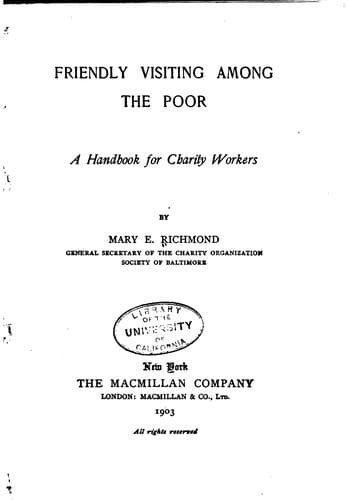
Friendly Visiting among the Poor: A Handbook for Charity WorkersRichmond, Mary Ellen
General
Friendly Visiting among the Poor: A Handbook for Charity Workers
Richmond, Mary Ellen
Friendly visiting
Proceedings of International Congress of Charities, Correction and
Philanthropy, Chicago, 1893, especially volumes on "Care of Children"
and "Organization of Charities." Published by Johns Hopkins Press,
Baltimore.
"Homes of the London Poor," Octavia Hill. For sale by New York State
Charities Aid Association, 25 cents.
"Essays," Octavia Hill. For sale by Boston Associated Charities;
price, 10 cents.
"Rich and Poor," Mrs. Bernard Bosanquet.
"How to help the Poor," Mrs. James T. Fields.
"Public Relief and Private Charity," Mrs. Josephine Shaw Lowell.
"American Charities," A. G. Warner.
"Hull House Maps and Papers."
{1}
FRIENDLY VISITING AMONG THE POOR
CHAPTER I
INTRODUCTION
There is a certain development in the English novel of which I have
long seemed to be vaguely conscious. At one time I hoped to set myself
the task of tracing it, though I have since relinquished all thought of
this as too ambitious. The movement--if, indeed, there be such a
movement--has always pictured itself to my mind as the march of the
plain and common people into the foreground of English fiction. I
venture to introduce the idea here, though it may appear foreign to my
subject, as illustrating another and equally important movement in the
development of charitable work.
Should any one ever turn over the pages of our two centuries' stock of
novels, with a view {2} to tracing this gradual development of interest
in the poor and unfortunate, he would find, of course, that facts have
a tantalizing way of moving in zigzags whenever one is anxious that
they should move forward in a straight line; but he would probably find
also that, in the earlier attempts of the novel writer to picture the
poor, they were drawn as mere puppets on which the richly endowed
heroes and heroines exercised their benevolence. Very likely he would
discover that, when at last the poor began to take an important part in
the action of the story, we were permitted to see them at first only
through a haze of sentimentality, so that, allowing for great advances
in the art of novel writing between the time of Richardson and the time
of Dickens, we still should find the astonishing characterizations of
"Pamela" reflected in the impossible virtues and melodramatic vices of
Dickens' poor people.
To Miss Edgeworth and Scott first, perhaps, and to George Eliot most of
all, we should find ourselves indebted for faithful studies of plain
people,--studies made with an eye single to {3} the object, and
leaving, therefore, no unlovely trait slurred over or excused, yet
giving us that perfect understanding of every-day people which is the
only true basis of sympathy with them. In America we are indebted to
such conscientious artists as Miss Jewett and Octave Thanet for a
similar enlargement of our sympathies through their life-like pictures
of the less sophisticated people of our own time.
Public-domain text, read in full here on John Shaqi.
Reviews
Reviews
No reviews yet
Be the first to share your thoughts on this work.
Join the Discussion
Join the discussion
Sign in to leave a comment or review.
Sign InorCreate an account