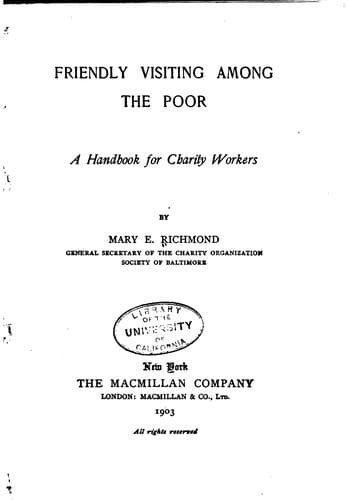
Friendly Visiting among the Poor: A Handbook for Charity WorkersRichmond, Mary Ellen
General
Friendly Visiting among the Poor: A Handbook for Charity Workers
Richmond, Mary Ellen
Friendly visiting
Any attempt to divide the poor into classes is to be deprecated,
because human beings are not easily classified. But, speaking roughly,
and using the classification merely as a temporary convenience, charity
workers will find that the thrift habit divides the poor into three
classes. First, those who are very thrifty, and this is a large class.
Misfortune may overtake the most provident during long periods of
industrial depression, or they may become temporarily dependent through
sickness or some unforeseen accident. The second class includes {112}
those who are willing to work when work is plentiful, but who have
little persistence or resourcefulness in procuring work. In the busy
season they spend lavishly on cheap pleasures and soon become
applicants for relief in troubled times. Debt has no terrors for them,
and, from their point of view, it is useless to save because they
cannot save enough to make it seem worth while. In the third class we
find the lazy and vicious, who shirk work, and, living by their wits,
are better off in bad times than in good. "It is with the second class
that the charitable may work lasting harm or lasting good. To let them
feel that no responsibility rests with them during the busy season, and
that all the responsibility rests with us to relieve their needs when
the busy season is over, rapidly pushes them into the third class. To
teach them, on the other hand, the power and cumulative value of the
saving habit, and so get them beforehand with the world, is to place
them in the first class and soon render them independent of our
material help." [2]
{113}
A characteristic of the second class is the habit of buying on credit.
The book at the corner grocery not only tempts the purchaser into
buying unnecessary things, but the prices are higher than the market
rate for inferior goods. A student in a university laboratory, who is
also a friendly visitor, had occasion to use some sugar in one of his
experiments, and, being hurried, purchased it from the nearest corner
grocery, paying more than the usual price. It proved to be badly
adulterated, and the user has been more careful since in advising his
poor friends about purchasing provisions. The credit system is the
natural outcome of uncertain income, and for that reason is hard to
avoid, but in a number of instances it is continued long after the
necessity that caused the buyer to ask credit has ceased to exist.
Public-domain text, read in full here on John Shaqi.
Reviews
Reviews
No reviews yet
Be the first to share your thoughts on this work.
Join the Discussion
Join the discussion
Sign in to leave a comment or review.
Sign InorCreate an account