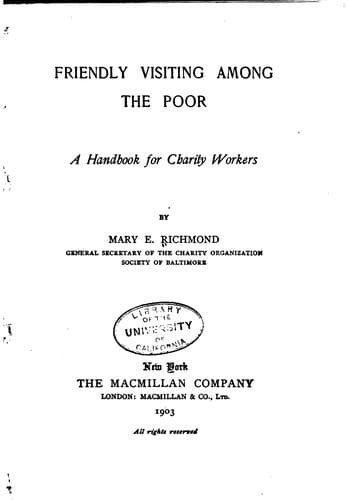
Friendly Visiting among the Poor: A Handbook for Charity WorkersRichmond, Mary Ellen
General
Friendly Visiting among the Poor: A Handbook for Charity Workers
Richmond, Mary Ellen
Friendly visiting
In teaching thrift in a careless and shiftless {125} home, we can get
many valuable suggestions from more thrifty families in the same
neighborhood, or with the same income. To effectively advise about
expenditure, one must know the family budget of receipts and
expenditures, and often this is more than the family knows. Learning
to take note of the items is the first lesson in thrift. The most
important thing, however, is our own attitude of mind. "We must not
get into the habit of saying, 'Poor things; they can do nothing.' We
should rid ourselves of the habit of treating them, not as men and
women, people who can look after themselves with strength in their
muscles and brain-power in their heads, but as animals whom we allow to
live in society along with ourselves, taking for granted that they are
deprived of, or cannot exert, those faculties which go to make up the
strength and fibre of men and women. I assure you, those who are
inclined to take a sentimental turn have great temptations put before
them to treat the poor as if they were dependent animals." [7]
{126}
Collateral Readings: "The Development of Thrift," Miss Mary Willcox
Brown. "The Standard of Life," Mrs. Bernard Bosanquet, especially the
essay on "The Burden of Small Debts." Annual Reports of the
Workingmen's Loan Association, Boston; the Provident Loan Association,
New York; and the Provident Loan Company, Buffalo. For stamp savings,
see reports of New York Charity Organization Society (Committee on
Penny Provident Fund).
[1] See Report on the Questions drawn up by Present Residents in our
College Settlements, p. 17. Published by the Church Social Union,
Boston.
[2] Leaflet on "Summer Savings," published by the Baltimore Charity
Organization Society.
[3] p. 25.
[4] "Public Relief and Private Charity," p. 109.
[5] See Fourth Report of Boston Associated Charities, p. 38.
[6] Eighteenth Report of Boston Associated Charities, p. 27.
[7] C. S. Loch in Fifteenth Report of Baltimore Charity Organization
Society.
{127}
CHAPTER VIII
RECREATION
I have said that the power to defer our pleasures is a mark of
civilization. There is another mark which, in this busy America of
ours, is often denied to the well-to-do as much as to the poor, and
that is the power to enjoy our pleasures after we have earned them.
Charity workers still underestimate the value of the power to enjoy.
They are likely to regard mere contentment as a model virtue in the
poor, whereas that discontent which has its root in more varied and
higher wants is a splendid spur to progress. Professor F. G. Peabody
quotes Lasalle in naming as one of the greatest obstructions to
progress among the poor, "The cursed habit of not wanting anything."
The power of enjoyment seems dead in many a down-trodden, sordid life,
while in many others it wastes itself upon unworthy and degrading
pleasures.
{128}
Public-domain text, read in full here on John Shaqi.
Reviews
Reviews
No reviews yet
Be the first to share your thoughts on this work.
Elsewhere in the archive
Join the Discussion
Join the discussion
Sign in to leave a comment or review.
Sign InorCreate an account