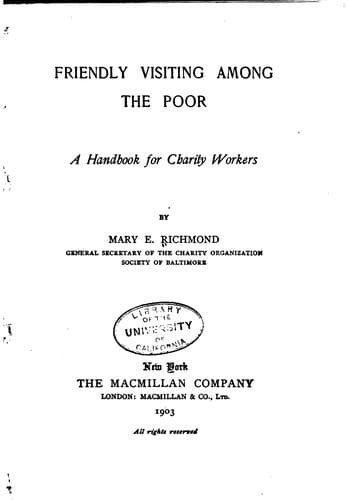
Friendly Visiting among the Poor: A Handbook for Charity WorkersRichmond, Mary Ellen
General
Friendly Visiting among the Poor: A Handbook for Charity Workers
Richmond, Mary Ellen
Friendly visiting
There is a passage in one of Miss Octavia Hill's essays that throws a
flood of light on this question. She says that the love of adventure,
the restlessness so characteristic of the Anglo-Saxon, makes him, under
certain conditions, the greatest of explorers and colonizers, and that
this same energy, under other conditions, helps to brutalize him.
Dissatisfied with the dull round of duties that poverty enforces upon
him, he seeks artificial excitement in the saloon and the gambling den.
It is useless to preach contentment to such a man. We must substitute
healthier excitements, other and better wants, or society will fail to
reform him. In all the forms of play, all the amusements of the
people, though some of them may seem to us coarse and degrading, there
is this same restless seeking to express what is highest and best in
man; not only to express his love of adventure, but his love of social
intercourse and his love of beauty. When we once realize that certain
vices are merely a perversion of good instincts, we have taken the
first step toward finding their cure.
{129}
It has been said that a man's pleasures give us his true measure, and
that to change the measure is to change the man. From this point of
view, the subject of recreation is very near the heart of the friendly
visitor's relation with the poor. We may have made a conscientious
study of the family expenses and income, of the sanitary surroundings,
of the work record and diet, but we shall not know the family until we
know what gives them pleasure. One visitor says that she never feels
acquainted with a poor family until she has had a good laugh with them.
A defective sense of humor in the visitor is a great hindrance to
successful work: poor people are no fonder of dismal folk than the rest
of us. When we come to recreations, friendly visiting not only makes
large demands upon what we know, but upon what we are. Our pleasures
measure us quite as much as they measure our poor friends, and, unless
we have kept fresh our own power of enjoyment, we cannot hope to impart
this power to the poor, or to give them new and better wants.
Granting that we have them ourselves, what {130} are some of the
healthy wants that we should try to pass on to the poor? Taking the
simplest first, we should try to introduce simple games and a love of
pure fun into the family circle. I am indebted to Miss Beale of the
Boston Children's Aid Society for the following list of simple games,
so arranged as to include standing and sitting games for each evening:
FIRST EVENING. SECOND EVENING.
1. Hiding the thimble. 1. Stage coach.
2. Bean bag. 2. Buzz.
3. Dominoes. 3. Elements.
THIRD EVENING. FOURTH EVENING.
1. Hot butter blue beans. 1. How, when, and where.
2. Jack straws. 2. Counting buzz.
3. Fruit basket. 3. Magical spelling.
Public-domain text, read in full here on John Shaqi.
Reviews
Reviews
No reviews yet
Be the first to share your thoughts on this work.
Elsewhere in the archive
Join the Discussion
Join the discussion
Sign in to leave a comment or review.
Sign InorCreate an account