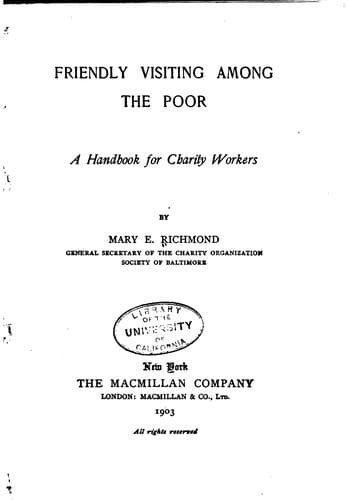
Friendly Visiting among the Poor: A Handbook for Charity WorkersRichmond, Mary Ellen
General
Friendly Visiting among the Poor: A Handbook for Charity Workers
Richmond, Mary Ellen
Friendly visiting
First of all--and this is a lesson that visitors are slow to learn--it
is very unwise, especially in the first months of acquaintance, for
friendly visitors to give money or commodities to the families they
visit, though they may find it necessary to see that relief is sent
from some other source. "If one of our visitors finds her family in
dire distress, and there is no time to go to the office and have aid
secured in some other way, she of course, like any one else, furnishes
it at once from her own pocket. But except in these rare emergencies,
our visitors do not themselves give relief to those they visit. We
believe this is a wise rule, and after eight years' experience we would
not change it. If a stranger offered you a gift, you would feel
insulted and refuse it Suppose you were constrained by necessity to
accept it--would it not make a certain bar between you and that
stranger very difficult to break down? Imagine yourself of a different
temper, that you wanted all you could get. Would you {143} not be
likely to talk more freely or truthfully to one who you knew would give
you nothing than to one from whom you hoped a plausible tale would draw
a dollar? For the visitor's sake also the rule is a good one. We are
apt to think our duty done if we have given money, and if we cannot do
that, we are forced to use our ingenuity to find other and better ways
of helping." [1]
It is eleven years since the foregoing passage was written, but the
experience of almost every practical worker in charity will confirm it.
Friendly visitors are human, and their task, as it has been described
in this book, is not an easy one. It is so much easier to give. But
the history of many volunteers in charity is that, starting out with
excellent intentions, they were tempted to give relief to the families
they visited. First it was clothing for the children, then the rent,
then groceries, then more clothing, and the family's needs, strange to
say, seemed to increase, until, finding their suggestions unheeded, and
{144} the people no better off, the volunteers deserted their post,
and, still worse, carried away a false, distorted idea of what poor
people are like. The poor, too, learn to distrust a charitable
interest that is not continuous. A little self-restraint, a little
more determination to keep their purpose clearly in mind, would save
the charitable and the poor from an experience that is hardening to
both.
Public-domain text, read in full here on John Shaqi.
Reviews
Reviews
No reviews yet
Be the first to share your thoughts on this work.
Elsewhere in the archive
Join the Discussion
Join the discussion
Sign in to leave a comment or review.
Sign InorCreate an account