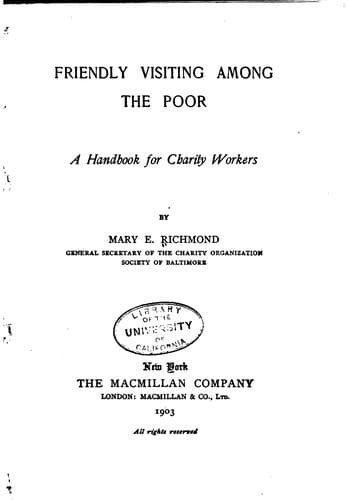
Friendly Visiting among the Poor: A Handbook for Charity WorkersRichmond, Mary Ellen
General
Friendly Visiting among the Poor: A Handbook for Charity Workers
Richmond, Mary Ellen
Friendly visiting
When the friendly visitor has known a family for years, and the
friendship is thoroughly established, it is conceivable that he may be
the best possible source of relief; but the attitude that we must guard
against--creeping, as it does, into all our relations with the poor as
an inheritance, an outworn tradition--is the attitude of the London
church visitor, who said that she could not possibly administer
spiritual consolation without a grocery ticket in her bag. It is good
for the poor and good for us to learn that other and more natural
relations are possible than the relations of giver and receiver, of
patron and patronized.
Nothing that has been said, however, against {145} permitting the
visitor to become the source of supplies should be interpreted as
meaning that the visitor is not to concern himself with the way in
which relief enters the home, and its effect upon the welfare of the
family. Everything that concerns the welfare of its members concerns
him, and that their energies should be paralyzed by a too plentiful
supply of relief, or that the lack of it should cause unnecessary
suffering, is a matter that concerns him vitally. To administer relief
wisely one needs special training, and an inexperienced visitor should
seek the advice of one who knows the charitable resources of his own
particular community and the standard of living of the family's
particular neighborhood. There are certain general relief principles
that common sense and experience have found to be applicable
everywhere, however, and, avoiding the technical language of charitable
experts, I shall try to state these principles as briefly and clearly
as possible, under six heads.
I. When relief is needed in a poor home, it should be given _in the
home_ without any {146} publicity, and after conference with the head
of the family, who, if unable to provide the means of subsistence
himself, is still responsible for procuring it. The man of the family,
unless disabled, should do all the asking. This means, of course, that
wives should not be sent to charity offices and private families to ask
assistance, and that every charitable agency, public and private, and
every church worker and every teacher should positively refuse to
receive any message or appeal for relief sent by a child, except in
those rare cases where all the adult members of the family are
disabled. The neglect of this simple precaution has often kept
children away from school, and has tempted parents to use them to
excite sympathy. One sensational item in a Baltimore daily, headed
"Barefooted through the Snow," was the account of thinly clad children
sent to the police station for relief. Their father, upon
investigation, was found to have taken their shoes off, and sent them
out to do the begging for the family, after refusing a good offer of
work.
{147}
Public-domain text, read in full here on John Shaqi.
Reviews
Reviews
No reviews yet
Be the first to share your thoughts on this work.
Elsewhere in the archive
Join the Discussion
Join the discussion
Sign in to leave a comment or review.
Sign InorCreate an account