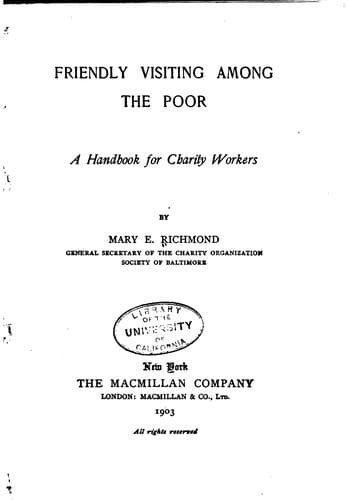
Friendly Visiting among the Poor: A Handbook for Charity WorkersRichmond, Mary Ellen
General
Friendly Visiting among the Poor: A Handbook for Charity Workers
Richmond, Mary Ellen
Friendly visiting
Turning from these more general considerations, it is proposed, in this
book, to treat of various aspects of the home life of the poor as {10}
affected by charity. At the very beginning, however, it may be well to
inquire, Who are the poor? If this were a study of the needs of the
rich, we should realize at once that they are a difficult class to
generalize about; rich people are understood to differ widely from each
other in tastes, aims, virtues, and vices. The great, conglomerate
class of the rich--which is really no social class at all--has included
human beings as different as Lord Shaftesbury and Mr. Barney Barnato.
But it is the very same with the poor; and any effort to go among them
for the purpose of helping them that does not frankly recognize this
wide diversity, must end in failure. The charity worker must rid
himself, first of all, of the conventional picture of the poor as
always either very abjectly needy, or else very abjectly grateful. He
must understand that an attitude of patronage toward the poor man is
likely to put the patron in as ridiculous a position as Mr. Pullet,
when he addressed his nephew, Tom Tulliver, as "Young Sir." Upon which
George Eliot remarks: "A boy's sheepishness is by no means a sign of
overmastering reverence; and while you are making {11} encouraging
advances to him under the idea that he is overwhelmed by a sense of
your age and wisdom, ten to one he is thinking you extremely queer."
The would-be philanthropist, who is very conscious of himself and only
vaguely conscious of the object of his benevolence, is likely to seem
and to be "extremely queer."
If I were writing about the rich, I should be inclined to divide them,
according to their attitude toward life, into workers and parasites,
but this classification will serve for the poor as well. The motto of
the worker is, "I owe the world a life," and the motto of the parasite
is, "The world owes me a living." When the parasite happens to be poor
we call him a pauper; but there is a world of difference between
poverty and pauperism. The poor man may become destitute through
stress of circumstances, and be forced to accept charity, but your true
pauper, be he rich or poor, has the parasitic habit of mind. When we
ask ourselves then, Who are the poor? we must answer that they include
widely divergent types of character,--the selfish and the {12}
unselfish, the noble and the mean, workers and parasites--and that, in
going among them, we must be prepared to meet human beings differing
often from ourselves, it may be, in trivial and external things, but
like ourselves in all else.
Public-domain text, read in full here on John Shaqi.
Reviews
Reviews
No reviews yet
Be the first to share your thoughts on this work.
Join the Discussion
Join the discussion
Sign in to leave a comment or review.
Sign InorCreate an account