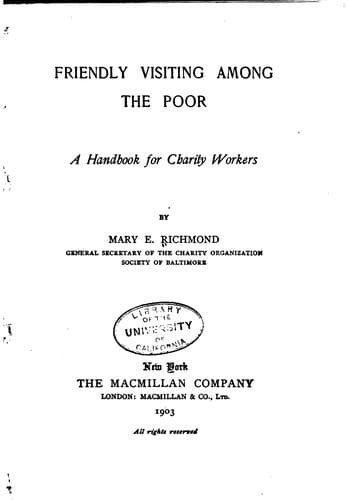
Friendly Visiting among the Poor: A Handbook for Charity WorkersRichmond, Mary Ellen
General
Friendly Visiting among the Poor: A Handbook for Charity Workers
Richmond, Mary Ellen
Friendly visiting
The fewer sources of relief for any one family the better, though it is
often impossible to get adequate relief from one source. "The
difficulty in giving judiciously is great, even where one person or
society does the whole. But when the applicant goes from one to {153}
another, undergoing repeated temptations to deceive and getting from no
one what is sufficient to meet the full need, each giver feeling but a
partial responsibility in the matter, one giving when another has
desired that relief ought to be withheld, and thus destroying the
effect of the other's action, we believe that the difficulties in the
way of judicious aid are greatly increased. . . . We earnestly hope
that the various relief-giving agencies may adopt the plan, so far as
possible, of a division of labor, each doing all the relief-giving
needed by those within its care and leaving others to do the
relief-giving in other cases." [2] When, however, relief must come
from a number of sources, it does most good if given through one
channel.
_The second relief principle is that we should seek the most natural
and least official sources of relief, bearing in mind the ties of
kinship, friendship, and neighborliness, and that we should avoid the
multiplication of sources._
III. In deciding to give or to withhold relief, we should be guided by
its probable effect upon the future of the applicant. When it is {154}
conceded that we should discriminate at all in giving, the popular
notion is that we should give to the worthy poor, and refuse aid to the
unworthy. The words "worthy" and "unworthy" mean very little; they are
mere catchwords to save us from thinking. When we say that people are
"worthy," we mean, I suppose, that they are worthy of material relief,
but no one is so worthy as to be absolutely relief-proof. If relief is
given without plan or purpose, it will injure the worthiest recipient.
On the other hand, an intelligent visitor can often see his way clear
to effect very great improvement in what are called "unworthy" cases,
and may find material relief a necessary means to this end. Better
than any hard and fast classification, is the principle that our relief
should always have a future to it, should be given as part of a
carefully devised plan for making the recipient permanently better off.
The only excuse for giving relief without a plan is that it is
sometimes necessary to give what is called "interim relief," to prevent
present suffering, until we can learn all the facts and a plan can be
devised. In this, relief work is very much like doctoring a sick {155}
patient. We have very little use for a doctor who does not alleviate
suffering promptly, but, on the other hand, we naturally mistrust the
doctor who does not ask a great many questions, or who fails to make a
plan for getting his patient beyond the need of medicine as soon as
possible. Our relief work is often nothing but aimless dosing. Like
Public-domain text, read in full here on John Shaqi.
Reviews
Reviews
No reviews yet
Be the first to share your thoughts on this work.
Elsewhere in the archive
Join the Discussion
Join the discussion
Sign in to leave a comment or review.
Sign InorCreate an account